
Empathy and Objectivity
10/9/25 - Thoughts after the passing of Jane Goodall

Hello everyone:
As always, please remember to scroll past the end of the essay to read some curated Anthropocene news.
Now on to this week’s writing:
I stepped outside on a recent morning to be greeted, while still on the steps, by an Autumn Meadowhawk dragonfly landing on the back of my hand. After a moment, he flew up to my sunlit shoulder, relaxed his four wings in a few brief motions, then glittered back at the sun as he has for 300 million years.
Earlier that morning, well before I was awake, Heather looked out the bathroom window to see a Whitetail doe on the lawn, next to our vegetable garden. The deer have been chewing their way through the garden this year - a first for us - probably because our veggies are some of the few well-watered plants in this drought that’s afflicting Maine. But the doe was, for the moment, politely feeding on the unwatered grass.
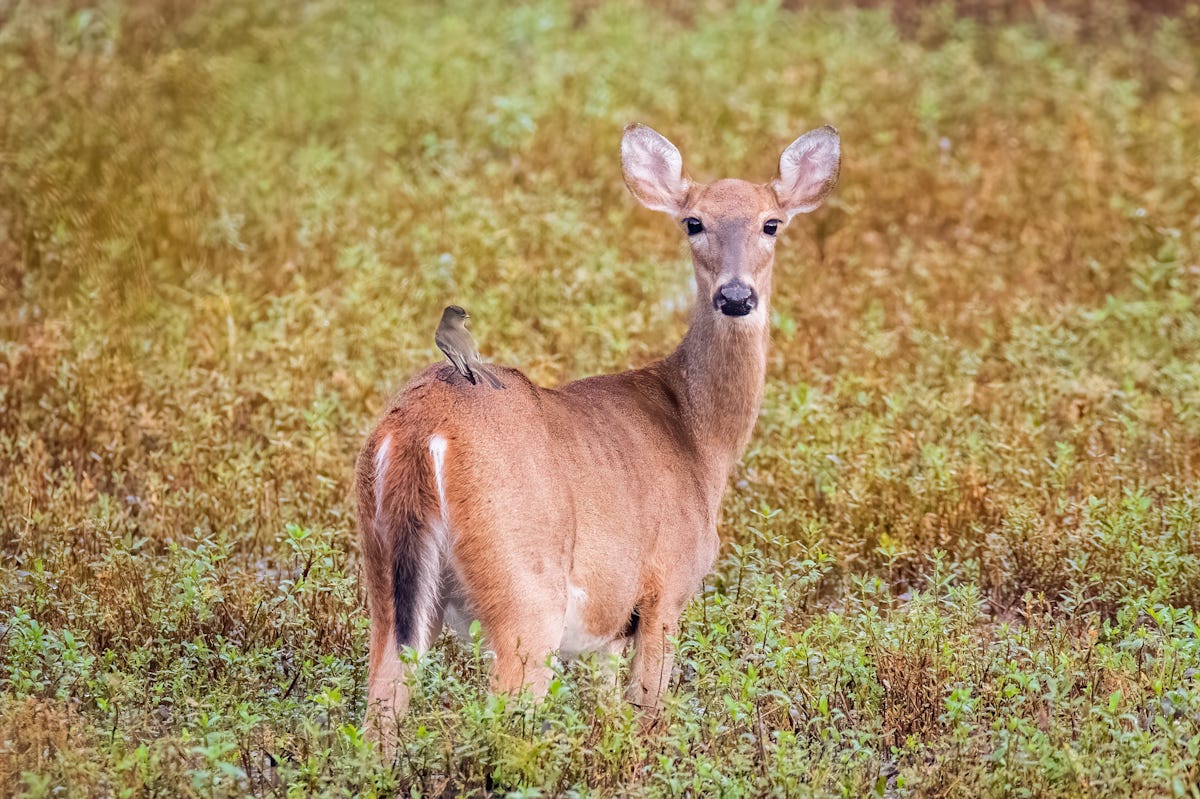
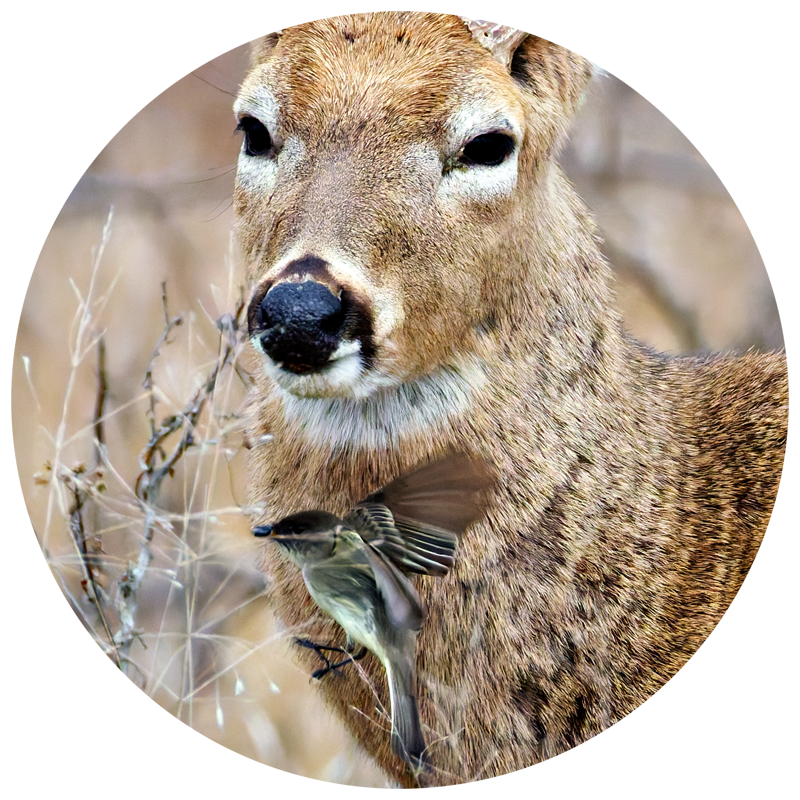
What caught Heather’s eye, though, were a pair of young Eastern Phoebes flitting back and forth between some sumac branches and the deer. The phoebes were browsing for insects on the doe’s back and behind her ears while she browsed on the grass. Then, Heather was amazed to see one of the phoebes (a flycatcher species which prefers to catch their prey on the wing) flutter in front of the deer’s face, then dart in and pull a tick from the corner of her eye. This happened two more times. In each moment, the doe reacted by calmly closed her eyes.
I tell you about the scene with the phoebes and deer in part because we’re astonished by it. It’s a new observation for us, and while we’ve found a study, and an article, it’s apparently not a well-known mutualistic behavior (one that benefits both species).
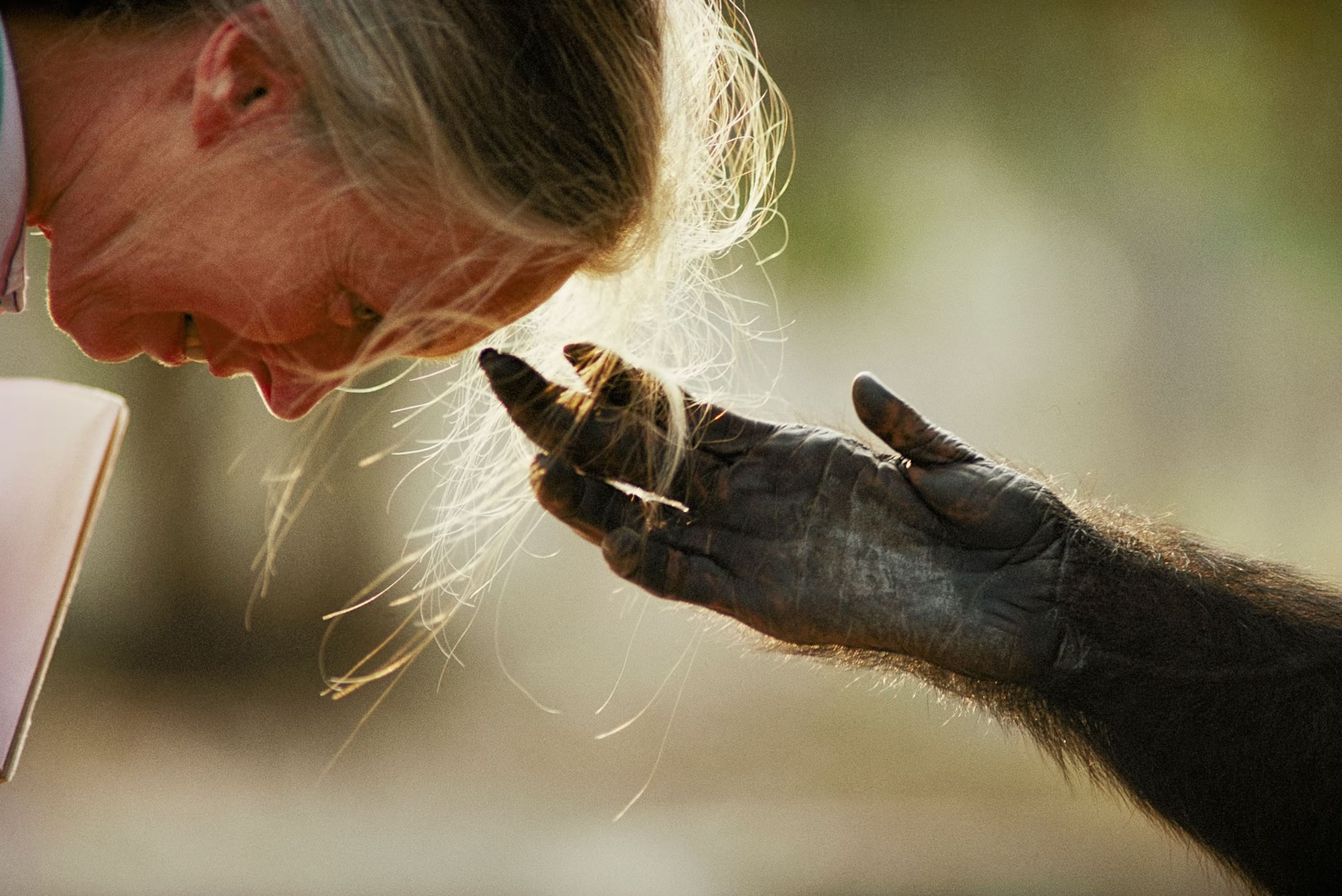
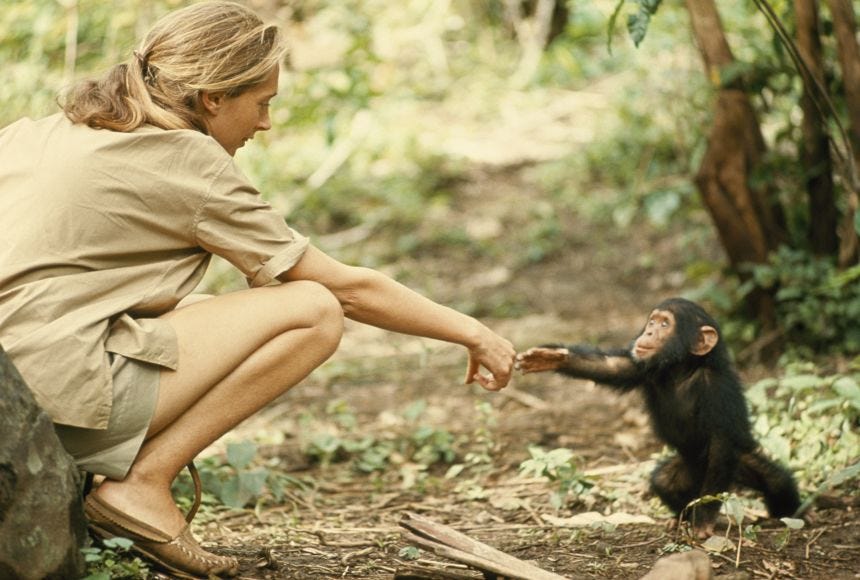
But I’m also telling you the story because, in the wake of Jane Goodall’s death, I’ve been thinking about her insistence that “empathy and objectivity can coexist.” That is, we can care deeply and think clearly at the same time. I think this philosophy of hers emerged from a lifetime of being a biologist who named and befriended the chimps she studied, a woman who spoke of Mother Nature, and a human who understood humans to be on the continuum of life rather than somehow above it. Such empathy, she was told, muddled her science and undermined the importance of her work.
But empathy was her life’s work, and should be ours as well. More to the point, empathy is objectivity, when it’s a clear-eyed recognition of what life is and what life needs.
Goodall knew that love is not a personal bias, not a prejudice, and neither an irrational emotion nor a false belief when that love is rooted in the fundamental truth that all of life is interdependent. Without a healthy ecological world, these strange temporary societies we’ve built from our fictional stories cannot exist. When we love chimps, dragonflies, birds, deer, and as we mature, every mysterious form of living creature, we are acknowledging our innumerable connections with them.
Empathy, I think, is the child of knowledge and love.
The detail that Heather and I find most marvelous in what she witnessed is also perhaps the most important, because it confirms the observation. The doe’s response to a bird fluttering at her face was to relax and close her eyes, as we do at the barbershop when the scissors approach our face. Like oxpeckers on a rhino or cleaner wrasse in the mouth of a shark, the phoebes provide a welcome service and benefit from it too. It is, as the ecologists say, a relationship.
Likewise, while basking in the morning sun on the front steps, neither the dragonfly nor I were objects, either in ourselves or to each other. Each of us is a living community woven inseparably into innumerable living communities of microbe, plant, and animal. Neither one of us is an individual - the word is meaningless, really, in ecological terms - and neither one of us is alone.
Heather and I and our shingled house and aster-filled yard are a mere pixel on this minor Maine peninsula, and the peninsula is only a pixel in this minor corner of the North American coast. The land and ocean flow outward from here in waves across global distances we can name but which are, in the end, beyond measure by our frail and temporary bodies. The world is larger than we pretend it is, far larger and more mysterious, and full of the only thing we can measure with our bodies: the beauty of life.
By any measure, the chimps, dragonflies, asters, and the quiet relationship between deer and phoebes are more real than the world we have conjured up to erase them and their communities. More real, I say, because they are the source of all that is beautiful, and more real because they are part of the 3.5 billion year old persistence of life, whereas a culture of erasure cannot live long. The culture of bulldozers, microplastics, and refinery flares claiming dominion over the Earth is as strange as a tick claiming victory over the deer, her favorite plants, and the sunlight that made them possible.
Maria Popova writes in The Marginalian that Jane Goodall was instrumental in helping modern society see our relationship with the natural world as exactly that, a relationship. As long as we live here on Earth, we have a family bond with all of life which can be violated by the bulldozers and coal smoke but not broken. Even better, Popova writes, Goodall reminds us with the example of her life that personal integrity and a devotion to saving what we can of the damaged world is a model for what a better world looks like:
It was [Alexander] Humboldt who first conceived of nature as a system, who saw “the unity and harmony of this stupendous mass of force and matter.” It was Jane Goodall whose science revealed that kinship is the software the system runs on, and whose life reminds us that just the kinship within a creature — the unity and harmony between all parts and passions of a person — is as essential to being fully alive as the kinship between creatures.
We live in a time haunted by men without integrity or empathy (or who consider it a weakness), who break these relationships in the service of what they weirdly think is a higher philosophy.
wrote recently of a self-described “theocratic fascist” with millions of social media followers railing against Pope Leo XIV, who on the 10th anniversary of Laudato Si’ continued the good environmental evangelizing of Pope Francis by asking us to “listen to the cry of the Earth and the cry of the poor.” The fascist described it as “horrifying.”But fascism, theocratic or otherwise, isn’t a philosophy. It’s a maladaptive psychology, one that can only persist within a fictional story that does not understand what life is and what life needs. Ditto the white supremacy, Christian nationalism, and misogyny of the Trump administration (and far too many other authoritarian governments). They are not instructive ways to live; they’re self-alienated ways to fail in an ecological reality, which is the only reality. They are, in a word, unnatural.
We must work to protect Mother Earth, because we need her to survive, as Jane might say, is a philosophy. It sounds naive in a world that moves fast and breaks things, but it is as solid as the planet amid the brief noise of a society built atop the ephemeral fluff we call technology and economics.
Goodall (an apt surname if there ever was one) spent the last several decades in constant motion on a mission to explain her philosophy, to help us to see animals and the natural world through her eyes, and to convince us to save as much of the Earth as we can by remaking society into something more rational, humble, and aligned with the principles of life. This woman who from the earliest days of childhood loved to sit quietly in nature instead moved from airport to airport, highway to highway, interview to interview, and crowd to crowd day after day and year after year. She founded Roots & Shoots, her global conservation organization for children, to “raise a generation of compassionate people.” Her sacrifice in the second half of her life was as extraordinary as what she taught us about animals and ourselves in her early career.
She has been a model of both empathy and objectivity for nearly a century, and has died in a time when both have become rare in public discourse.
Her legacy is simply extraordinary. To go deeper into that legacy and learn how she articulated a path forward for each of us, there are many, many resources. Start, perhaps, with her work at JaneGoodall.org, which includes links to her Good For All conservation news and Roots & Shoots. Or watch any of the documentaries about her, like the National Geographic film, JANE, or read some of her 32 books. There has been an outpouring of obituaries and remembrances; I liked the poignant “What Jane Goodall showed me about hope” by Rhett Ayers Butler at Nature Briefs.
I also highly recommend an excerpt from In the Forests of Gombe, published in Orion some years ago, in which Goodall writes beautifully about being in the forest, moving through grief into solace, and maintaining a spirituality that recognizes our place within, and takes responsibility for, nature.
Or you can lay back and listen to “What It Means to be Human,” her 2020 conversation with Krista Tippet of On Being, in which she discusses the value of empathy amid the scientific quest for objectivity:
it’s the empathy that gives… that intuition, that aha moment, which you wouldn’t get if you didn’t have empathy, I don’t think. And also, the cold, scientific approach, I believe, has led to a lot of suffering on this planet.
Heather and I just watched the new Netflix Famous Last Words interview with Goodall, which was recorded earlier this year and set aside to be released only after her death. Here is her heartwarming conclusion:
But maybe it’s best to set aside the digital world for a while and go outside to invite a dragonfly to visit your shoulder, and to experience relationships within the beautiful world that you might not have seen before.
As I write this, a bluebird is in the birdbath, sparrows and mourning doves are feeding in the unmowed lawn, a phoebe is flitting above all of them in her search for the insects built from plants and sunlight, and the deer and ticks are feeding somewhere out of sight. Everyone is preparing for the season’s first frost tonight, including Heather and me. Time to go outside.
Thanks for sticking with me.
In other Anthropocene news:
From Mary Holland at Naturally Curious, “Save Your Spring Cleaning for Spring,” some excellent advice for gardeners who are in the habit of doing thorough fall clean-ups of their flower beds. It’s much better to wait until the spring, when temperatures have been in the 50s for several days, and any insects that have wintered over in the vegetation have matured and moved on:
Those of us of a certain age grew up having “fall clean-ups” in our flower gardens every year. Everything was cut down to the ground, raked up and disposed of. Today we’ve learned that hacking down every vestige of garden vegetation in the fall is depriving birds, butterflies, bees and innumerable other insects and creatures of food sources and winter habitat.
From Earth Island Journal, a difficult, heartbreaking, but also heartwarming story of ending the cruel practice of bear bile farming in Vietnam. The article follows one Asiatic black bear in particular, Chinh, who (like all such bears) has spent years locked in a tiny cage, but has been brought back to health and released into a sanctuary with other rescued bears where they will be nurtured for the rest of their lives.
From my wife
and A Nest of Songs, “The Crow,” a sad, beautiful song about a boy who shoots a crow, realizing only too late the consequence of what he has done. Heather includes a wonderful, relevant story about her father too. If you’re interested in nature-focused songs, please check out her other work, including a birthday sonnet she wrote for me and then set to music.Something that was not on my radar at all: From Interesting Engineering, a floating, zeppelin-like megawatt-scale wind turbine that can be deployed thousands of feet in the air and tethered by a cable that conveys the electricity to the ground. These Chinese-made turbines can be set up quickly - useful for disaster-relief work - and are built to take advantage of the strong and steady winds at low altitude:
The physics of wind power makes this resource extremely valuable. “When wind speed doubles, the energy it carries increases eightfold; triple the speed, and you have 27 times the energy,” explained Gong Zeqi, a researcher from AIR.
Probably most of you have already read this, but just in case: From
and The Crucial Years, “It’s hard to drone a solar panel,” an update from Ukraine and their heroic push to transform their energy networks to renewables in part because it’s good economic and ecological sense, but mostly because renewables create a distributed grid that cannot be easily disrupted by Russian missiles.From
and Global Nature Beat, another amazing round-up of conservation news, from conferences and papers to articles and jobs in environmental journalism. It’s worth your time to peruse Nature Beat even if all you want is the heartening experience of glimpsing the scale of conservation work being done on the ground and in policy-making around the globe.From Yale e360, a new mandate in the EU for the installation of sophisticated sewage treatment technology for eliminating the flood of micropollutants from pharmaceutical and cosmetic companies is getting pushback from those companies, because the EU plans on making them pay for it.
Also from Yale e360, an interview with Hannah Ritchie, who provides an incredibly rational, calm optimism about the speed and direction the world is going on ditching fossil fuels in favor of electrification. The interview is short and simple, but worth your time if you want some clarity.
From Anthropocene, the staggering difference in ecological footprint (paw-print?) between feeding a plant-based or meat-based diet to your dogs. Emissions from the global pet food industry are the equivalent of those from the Philippines. Likewise, land use, water use, and freshwater contamination from the agriculture necessary to feed our pets are enormous. The study showed that just as limiting our own meat intake is a great way to reduce our impact, we can reduce to a small fraction the environmental cost of feeding our pets but using plant-based foods.
Thank you for sticking with us, Jason. Thank you and Heather for noticing, reporting and connecting us with what beckons attention.
I wish I could share our rain storms with Maine. The abundance is a bit unsettling given the circumstances leading us to the Storm a year ago. Repairs continue: there are many bulldozers and dump trucks on the road. The yellow swallowtails seem unbothered and provide a show that brings me to giggle at each portable stop light; landslide by landslide is made passable.
I have recently returned from the headwaters of the Swannanoa River. The Great Blue Heron is gone. The water runs fast and too deep now. I am on a slow publication schedule as I research the hydrological changes. I feel fortunate to notice (on the ground) but it’s time to translate my findings. Empathy and objectivity, indeed. Merci.
Jane Goodall, model
Objective, empathic, both
May Roots s & Shoots grow