
Cease Fire
3/5/26 - The possibilities of a Fossil-Free Nonproliferation Treaty


Hello everyone:
I begin this week talking about the war in Iran and the depredations of the fossil fuel industry, but stick with me: The writing leads to a fascinating proposal for helping to force that industry, finally, into the dustbin of history.
As always, please remember to scroll past the end of the essay to read some curated Anthropocene news.
Now on to this week’s writing:

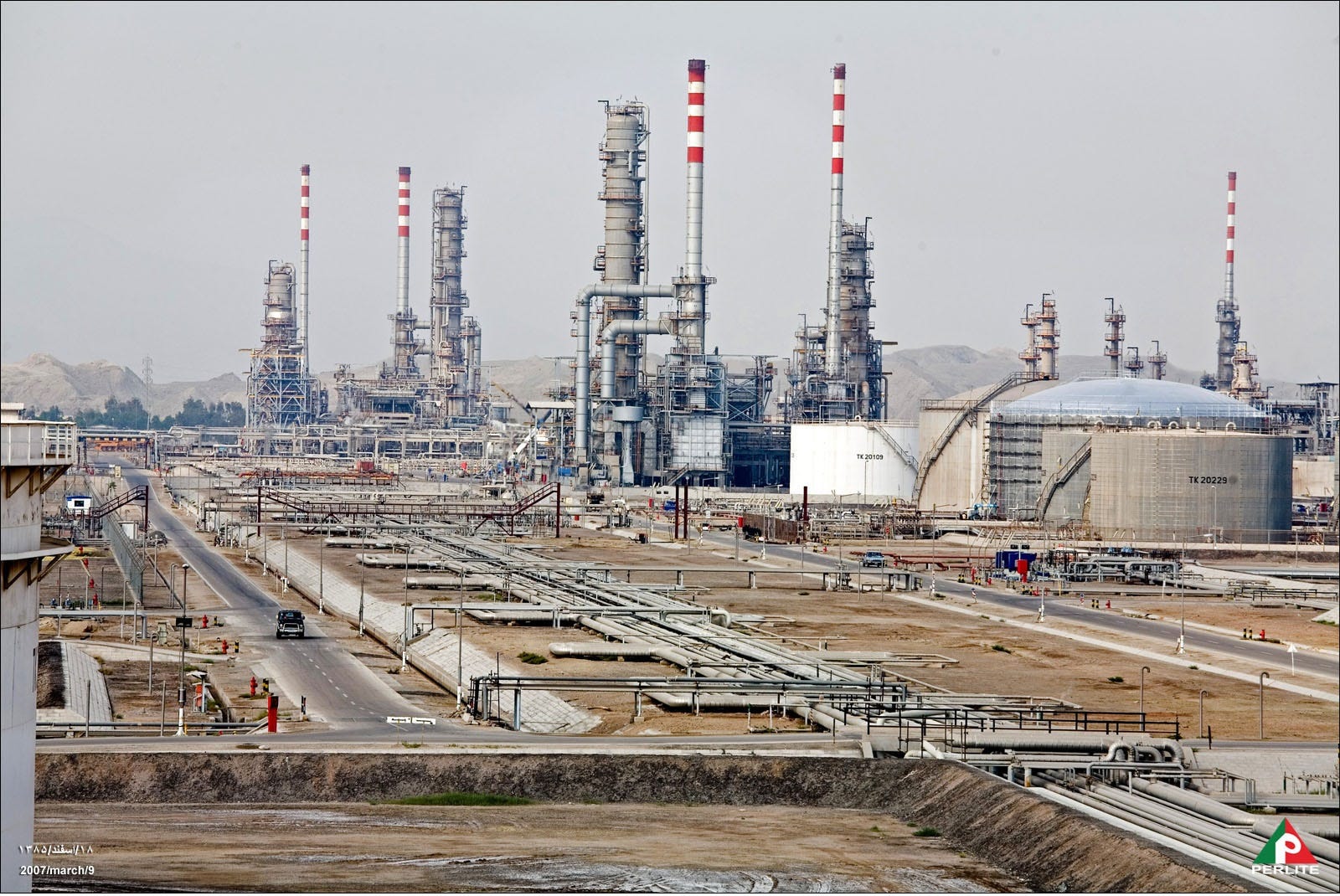
The war against Iran reminds us of so much that ails us at this moment in history. By “us”, I mean both Americans specifically and humans more broadly. And by “this moment in history,” I mean both the current U.S. administration with its extraordinary corruption (financial, anti-democratic, moral) and modern civilization’s rapid transformation of conditions for life on Earth. The heat and erasures of modern war are, after all, a reflection of the heat and erasures of the Anthropocene. We burn what we should love.
“The major problems in the world,” Gregory Bateson reminded us, “are the result of the differences between how nature works and the way people think.”
I make no claim to a clear understanding of why this war, why now, and what happens next. It may be a convenient merging of Sunni vs. Shia violence, Israeli hard-line geopolitics, and some half-witted Armageddon-seeking religious extremism from Christian nationalists in the U.S. military. But scholar of authoritarianism Timothy Snyder makes some compelling arguments and asks some crucial questions about the facts of America in this moment. “These facts,” he writes, “suggest two interpretive frameworks: a foreign war as a mechanism to destroy democracy at home; and a foreign war as an element of personal corruption by the president of the United States.” There’s too much to unpack there, so I’ll focus on just one element, and a possible long-term solution that is probably not on your radar.
Though he doesn’t mention it, Snyder’s frameworks include in their logic the dark motivations of the fossil fuel industry. The very public pay-to-play corruption of the Trump administration includes a deal to do that industry’s bidding after receiving tens of millions of dollars in campaign funds (or perhaps much more, in the dark money reality of U.S. politics). That’s why the last year has been full of new tax breaks for oil and gas companies, overturned pollution regulations, incentives for more drilling, and an obstacle course of executive orders against the (inevitable) clean energy revolution.
Modern democracy, representing people’s desire to shift rapidly to cleaner energy sources, is no longer good for the oil and gas industry’s bottom line.
Of course, fossil fuels have always been more of a logistical than moral good. War and oil have been inextricably linked from the beginning of this fossil-fueled era. As 20th century societies powered up on coal and oil, so did militaries. As fossil fuel resources became invaluable, conflicts became inevitable. Too often, national governments merged with their industry into petrostates, perverting democratic interests into oil-stained profits.
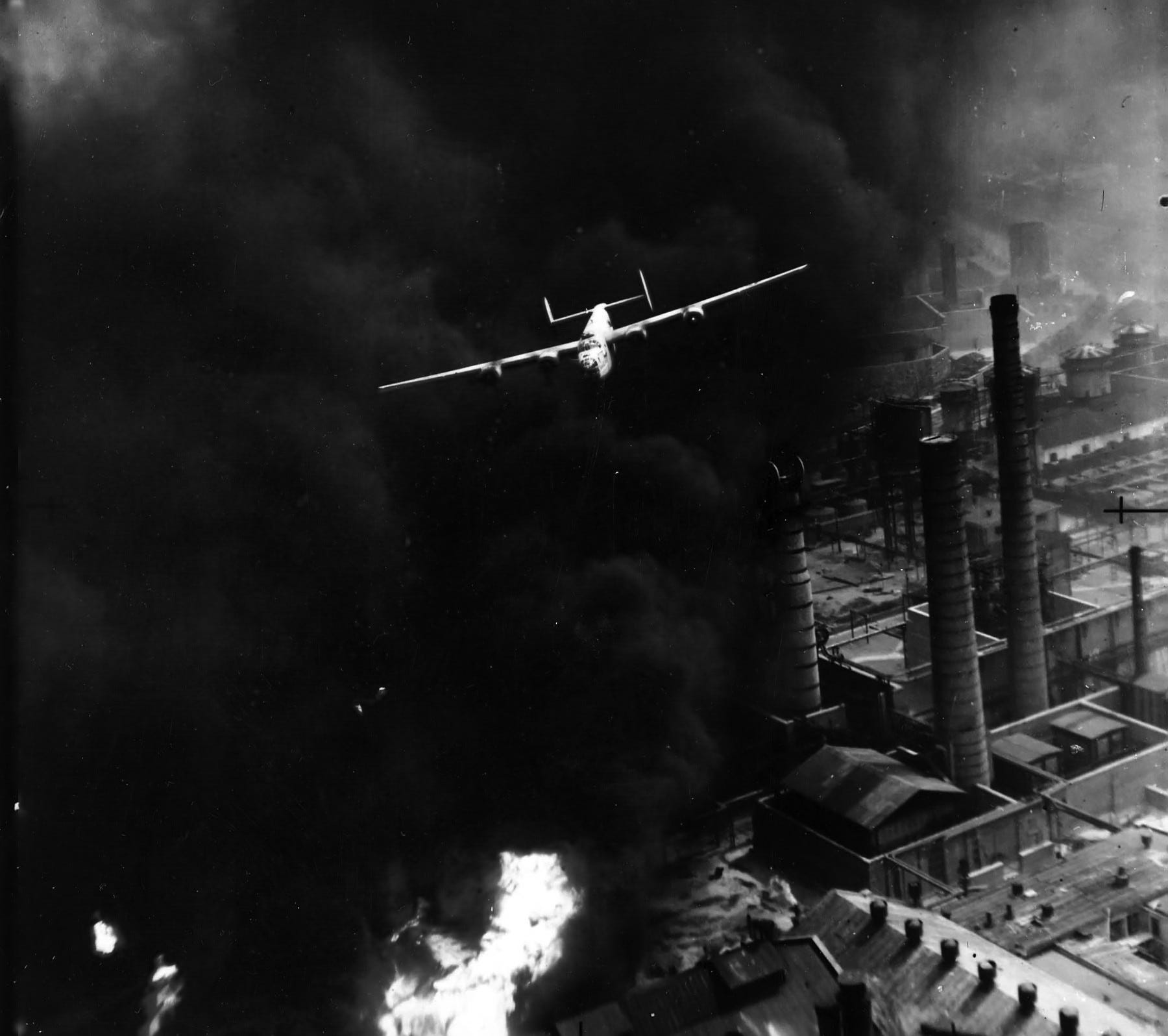
But national strength, coalescing around a critical resource, became fragility on the world stage. The “structural vulnerability” of a world reliant on “a system tied to a volatile, conflict-driven industry” is as obvious today, with Tehran in flames, as it was when oil powered the global horrors of the first and second world wars. Lord Curzon, British war minister during WWI, wrote that the Allies “floated to victory on a wave of oil.” The Lord did not mention all the life that drowned beneath that wave.

Reflecting on today’s conflict with Iran, scientist James Gleick said this week, via Mastodon, that
The world is getting a reminder, once again, of the enormous economic and geopolitical risks associated with dependence on fossil fuels. And a reminder of the incredible independence that renewable energy provides from those risks.
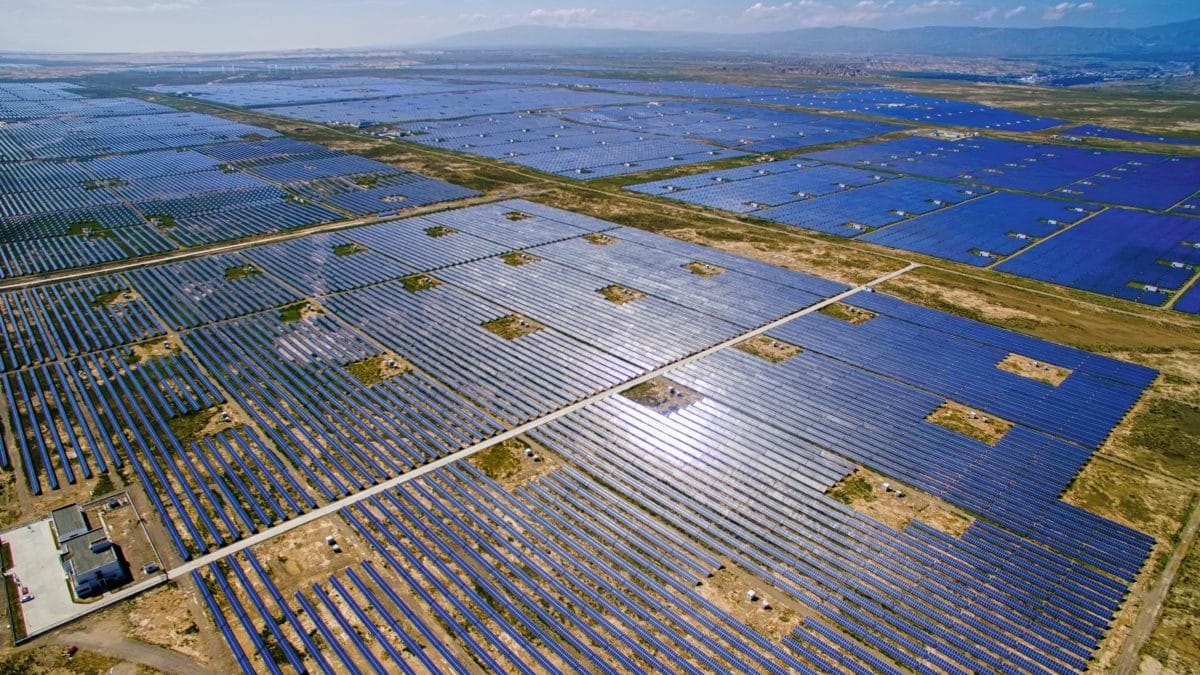
And here’s a quick and effective video explainer from scientist Chris Gloninger that nicely mocks the idea that solar and wind are somehow more unreliable sources of energy than oil and gas. (Thanks to Andy Revkin for the link.) Sun and wind cannot be embargoed, and thousands of solar panels are much harder to bomb than a single large refinery. Crucially, renewable energy sources don’t have a supply chain that’s vulnerable to disturbances at any time and any place on Earth. They derive their power locally, rather than from oil and gas fields on other continents and from tankers navigating a conflict-ridden world.
And then there’s the bottom line. Solar, in particular, is now radically cheaper and more efficient than fossil fuels. As the International Energy Agency (IEA) wrote in a 2024 report,
For comparison, a single journey by a large container ship filled with solar PV modules can provide the means to produce as much electricity as would be generated from the natural gas onboard more than 50 large liquefied natural gas (LNG) tankers, or from coal onboard 100 large ships.
You probably already know much of this, or at least the general idea that fossil fuels are as dangerous and outdated now as their industry is powerful, bloated, and corrupt. You know that we must, as Bill McKibben has been saying for years, stop burning things. You know that just as we need a ceasefire in all these oil-driven wars, we need to cease fire…
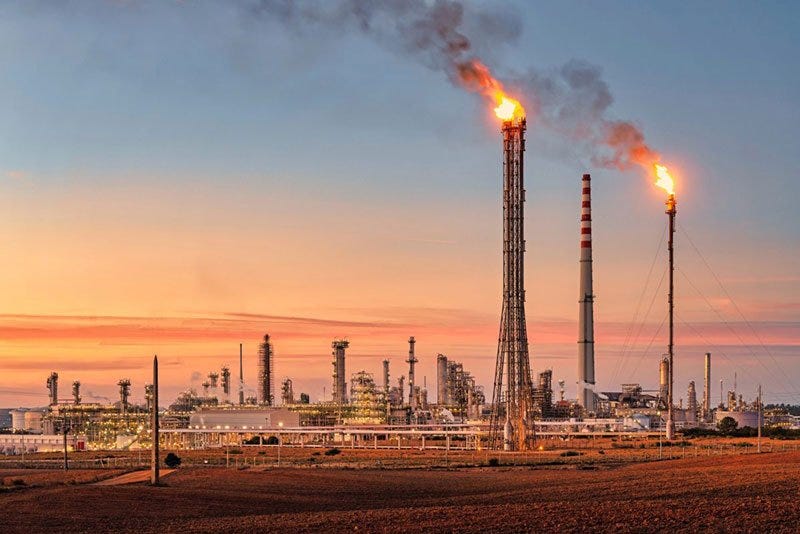
But in a political era driven by the forces who oppose both of those ceasefires, the task seems Herculean. The good news is that the economics of solar, wind, and batteries are writing the obituary for fossil fuels on a faster timeline than most people realize, though it’s still not fast enough. What intrigues me, then, is another idea that could accelerate the transition with political leverage: The Fossil Fuel Treaty (FFT).
The FFT was originally the FFNPT, with NP for Non-Proliferation, because the treaty idea finds its inspiration in nuclear arms non-proliferation treaties signed by otherwise intractable Cold War foes. The idea is to create a binding agreement to phase out fossil fuel use in as quick and fair manner as possible. Its three principles are
Just Transition - Accelerate a fair shift to diversified, accessible, renewable energy
Non-Proliferation - create the conditions to ensure the end of the expansion of oil, gas and coal
Equitable Phase Out - Wind down existing fossil fuels to safe levels with wealthy countries leading and supporting others to join
I first bumped into the idea of the fossil fuel treaty a year and a half ago in a DeSmog interview with Canadian environmentalist Tzeporah Berman. I’ve been meaning to investigate it ever since, and now that we’ve crossed the light crude Rubicon in Iran, this seems like a good time. When asked why a treaty might be a solution to the fossil fuel problem, Berman said “I would say this is a moment in history where we need bold new ideas. This is a bold new idea, and we can’t afford to not try it.”
Already, according to the Fossil Fuel Treaty site, a bloc of 18 countries has begun discussions, and they are
backed by a growing network including over 4,200 civil society organisations, more than 146 sub-national governments, 800+ parliamentarians, 101 Nobel Laureates, 3,000 scientists and more than 1 million individuals.
That network includes the World Health Organization, the European Parliament, members of the Vatican’s Holy See, governments and organizations across the Pacific region, the states of California and Hawaii, and cities across the globe from London and Paris to Wellington (NZ) and Sydney (AUS), from Portland (Maine) to Lilongwe (Malawi).
And things are happening. The first Conference on Transitioning Away from Fossil Fuels will be held at the end of April, in the coal export city of Santa Marta, Colombia. (The Netherlands are co-hosting with Colombia.) The conference builds on two recent proclamations: The first is an advisory opinion from the International Court of Justice that governments are legally required to address climate change, and the second is the Belém Declaration on the Transition Away from Fossil Fuels, a non-binding statement produced at COP30 and endorsed by 24 nations.
The Belém Declaration grew out of many years of frustration with the slow, industry-weakened COP process. Unlike every COP document to appear so far, the Declaration unabashedly names fossil fuels as the primary driver of climate change and pushes for faster, science-based action to shape global policy around the goals of the Paris Agreement.
The FFT conference on transitioning away from fossil fuels will work mostly outside the UN process to build a global coalition and create a set of agreements that can then act as leverage on the larger stage where, for now, industry and petrostates hold power. It’s modeled on a variety of international conferences held to face up to global threats from what Berman calls “intransigent products.” On the environmental side, an incredibly successful example is the Montreal Protocol on ozone-depleting chemicals. On the geopolitical side, there are the first nuclear arms treaties, as I noted above, and the Ottawa Conference to address land mines and the Oslo Conference on cluster munitions.
Some nations (notably Russia and the U.S.) never signed those latter treaties, but the agreements have had an enormous impact nonetheless on the majority of nations which put human rights and social justice ahead of military-industrial profits. A similar outcome seems likely for the FFT.
It’s helpful to see the FFT as an attempt to control the supply-side of the fossil fuel problem. The story of our civilization wrestling with a catastrophically dangerous energy source is so far a demand-side story. Users of fossil fuels, whether nations or families, are switching to cleaner, cheaper sources of energy. That side of the equation, as the picture below demonstrates, has advanced rapidly, but developing economies require more and more energy, wherever they can find it.
Meanwhile, the suppliers are doing all they can to increase production, prolong the use of fossil fuels as long as possible, and avoid legal or moral responsibility for the immense harm they continue to wreak on all of life on Earth. As a result, fossil fuel use has continued to increase. Its peak, and then decline, are close, but it’s decades later than it should be.
It is tempting, given the extraordinary growth in clean, affordable, energy sources - solar and batteries in particular, but also wind, geothermal, and more - to let the market do its work. Surely, fossil fuels will die quickly under the weight of their higher costs, fragile supply lines, and shrinking demand? On a level playing field, perhaps. But the global industry has floated to economic victory over the last century on a wave of subsidies. As Tzeporah Berman noted in her interview,
the markets aren’t constraining production, because the markets are distorted by the $7-8 trillion the IMF says were given in fossil fuel subsidies last year; that’s $13 million a minute. These are the most powerful companies on Earth, and most profitable companies on Earth, and they continue to hold influence so that they can grow and expand their products.
Of that $7-8 trillion, $1.5 trillion is in explicit subsidies and the rest is an estimate of the costs to society (health and environmental) for which the industry is not held to account. Of course, here in the U.S., the Trump administration has increased subsidies to the industry by $3.5 billion per year (on top of the existing $31 billion) in its recent budget bill, and Republicans in Congress are working to provide legal immunity for the industry as it faces a landslide of lawsuits seeking some of the money it owes for those impacts to human health, the climate, and the environment.
This is a reminder that the Fossil Fuel Treaty isn’t simply looking to limit the climate impacts of coal, oil, and gas. A treaty that forced a phase-out of fossil fuels would also free up those funds wasted on subsidies, reduce the millions of premature deaths each year from related pollution, ease the many catastrophic impacts on planetary boundaries specific to fossil fuels, and provide energy independence for the many nations able to source their own power from clean, local sources.
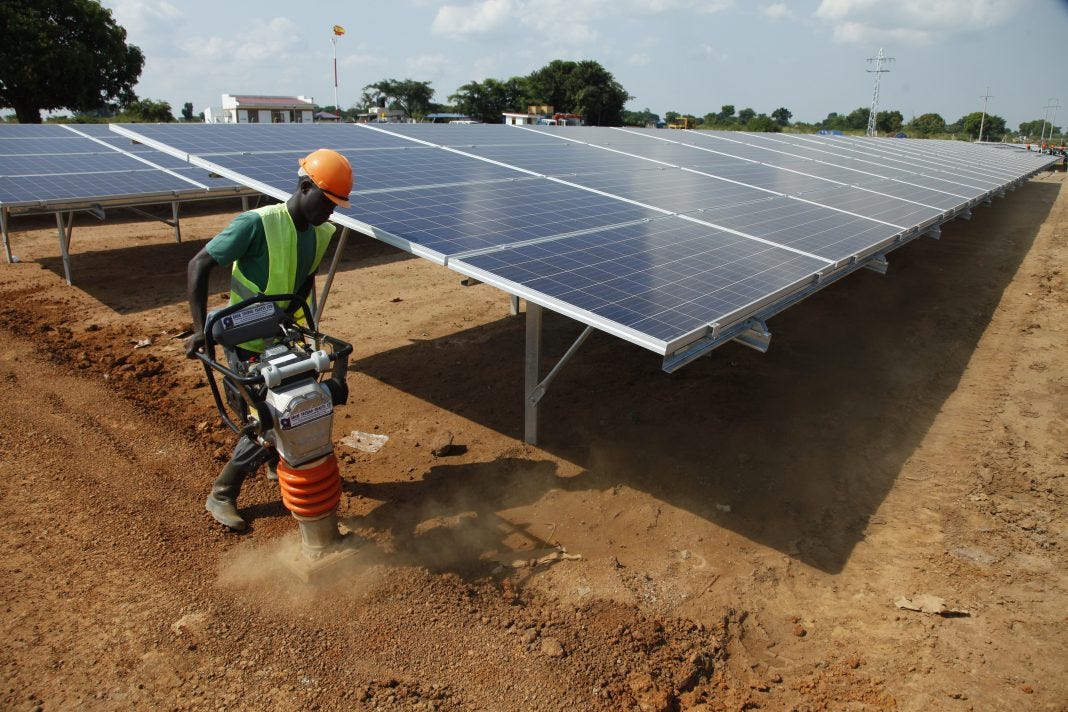
Treaties like this are enormously complicated, even without pushback from some of the largest economic forces in the world, because they require the constraint of an economic activity. Leaving trillions of dollars of oil and gas in the ground does not come easily in a world ruled by human weakness.
Yet the FFT is further complicated by the prospect of negotiating a fossil fuel phase-out between nations both rich and poor. Unlike, say, ozone-eating chemicals produced by a handful of companies, or nuclear weapons developed by a few governments, fossil fuels are woven into the daily lives of everyone on Earth. Eliminating subsidies for (and raising taxes on) the fossil fuel trade will make these energy sources more expensive, which for poorer communities will do more harm than good. It can be done fairly, but it may be a very fraught process.
And those are just some of the political and economic elements. A Volts podcast that just dropped this week, “The fate of the fossil fuel system - in the mid-transition,” provides really fascinating insights into how we might get through the strange and difficult energy transition phase in which the rise of renewables and the decline of fossil fuels must play well together in the energy and economic landscapes. The world has been tied together by those fragile oil/gas/coal supply chains, and now they have to be untied, unbuilt, and reimagined. As Volts host David Roberts says in his intro, we’re used to imagining a world powered by clean energy, but tend not to imagine what the halfway point looks like:
In the energy forecasting models, the fossil fuel systems gradually decline as the clean systems gradually grow to replace them — one line goes smoothly down as the other goes smoothly up. But as we know from … everything that’s ever happened, lines do not move smoothly in real life. What’s going to happen to those fossil fuel systems as they shrink? Are they going to phase out in a way that is economically rational or equitable? Are they going to hand off to the systems that replace them in a way that preserves reliability and safety?
Berman says that, broadly, the FFT process includes an agreement 1) to stop expanding fossil fuel production, 2) to wind down production while deciding “who gets to produce, and how much,” and 3) “to fast track the Just Transition.” There is a library to be written about what’s involved, in detail, for each of these steps, but some sources include Fossil Fuel Exit Strategy, a 2021 booklet from the Australian Institute for Sustainable Futures; two good Wikipedia pages on the FFT and the fossil fuel phase-out; and of course the Fossil Fuel Treaty site, where the FAQ page may be a good starting point.
Without the built-in weaknesses of the UN process - petrostate veto power, thousands of industry lobbyists, etc. - a treaty process could be relatively quick. From this April’s conference, treaty negotiations may be only a few years off. The broad coalition of people, organizations, and nations behind the FFT initiative are cautiously optimistic, it seems:
History proves that achieving a Fossil Fuel Treaty is possible. From landmines to ozone depleting chemicals - politics, economics and social norms can change when a group of first mover political leaders and countries, spurred on by civil society and ordinary people, decide to look at threats to humanity for what they are - and do something about it.
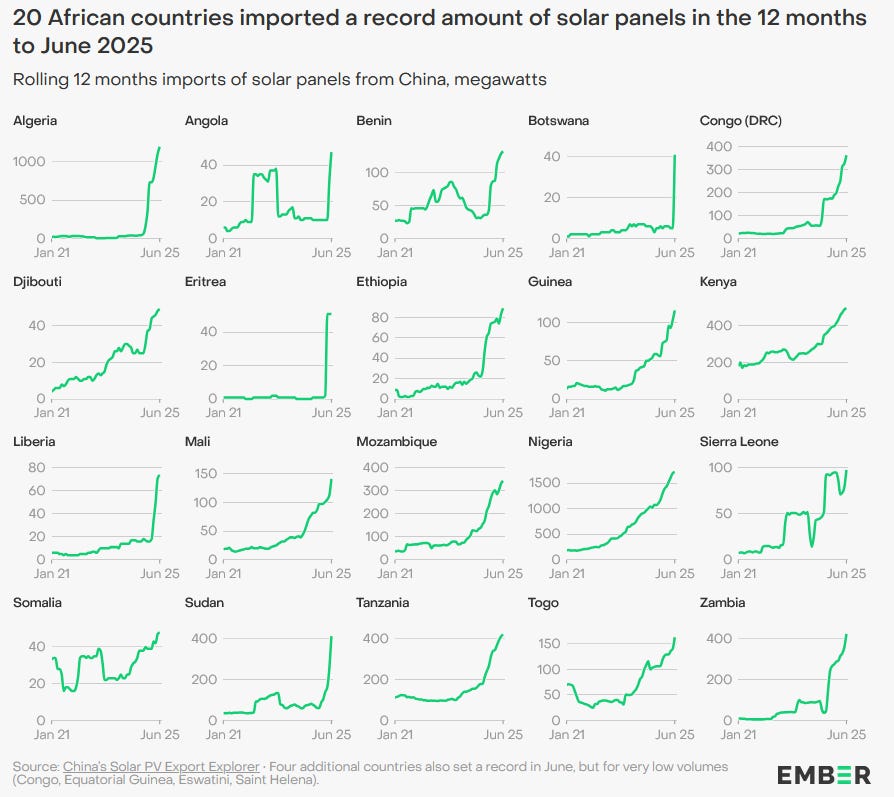
And I keep coming back to the demand-side of the equation, which is so much further along than most people realize. The flood of affordable Chinese solar panels across the globe, and the irrepressible rise of clean energy production and installation by countries large and small, represent a transition unlike any in human history. It’s societies powering up, but far faster than the rise of fossil fuels, and with far more care for a universal quality of life.
The incredible surge of small-scale solar installation in Pakistan, which now makes up much of the available energy in the country, has become well-known. But a recent report from Ember highlights a similar surge beginning across Africa, as the image above makes clear. And the economics of the transition are obvious. In Nigeria, for example, a solar panel can be paid off with just six months of not paying for diesel fuel. There’s no going back.
Which makes me think that, given these economics of renewables even in the face of trillions of dollars in oil and gas subsidies, it may be that the FFT won’t have to become a powerful international lever anchored by most of the world’s wealthiest countries fighting their own entrenched interests. It may only need to be another large nail in the coffin of an industry finally, finally, facing up to its poisoning of human and environmental health, its moral failings, and an economic reckoning both in the open market and in the courts that bring it to heel.
I’ll close by looking at all this from the outside. And by “outside,” I mean the real world, where life is. The International Union for Conservation of Nature, made up of organizations in 160 countries (including many government conservation agencies and environmental groups like The National Audubon Society, The Center for Biological Diversity, and The Nature Conservancy) is now part of the FFT coalition. In response, an environment minister for Vanuatu, an island nation deeply threatened by a hotter world, praised them for finally waking up:
For the first time, the IUCN has recognised what science has been telling us for decades: we cannot protect nature while expanding fossil fuels.
And finally, the Fossil Fuel Treaty, whether it succeeds or not, seems like an abstraction in a world of earthly woes, but Berman makes a case for it as an act of love. Love, she learned in an epiphany moment while talking with an Indigenous elder in the Ecuadorian Amazon, is one of the three principles of true wealth. The elder had recently acquired a computer, Wi-Fi, and a solar panel, and had been investigating our culture. He was perplexed by our insistence on wealth as paper and coin. “We define wealth,” he told her, “as love, a strong community, and a healthy forest that brings us our air and water and food and medicine.”
That, to me, seems like a lesson in bringing together the way people think with how nature works.
Thanks for sticking with me.
In other Anthropocene news:
From DarkSky.org, an opportunity (before March 9th) to speak out against two insane proposals to fill the sky with (even more) satellites that Earth’s orbit and atmosphere simply cannot sustain. The FCC is reviewing two proposals, one from Reflect Orbital and the other from SpaceX, and they’re taking public comments now. The DarkSky page has very specific instructions for what is a not-so-simple comment process, so read it carefully. As far as the problems with the proposals, the gist is this: Reflect Orbital wants to launch a vast host of satellites that will reflect sunlight back to Earth as a way to profit from providing 24-hr solar power and illuminating cities. That’s a ridiculous boondoggle. SpaceX, meanwhile, wants to launch up to a million satellites as “orbital data centers” to house a globe-encircling artificial intelligence network. That’s extraordinarily dumb and dangerous. There’s too much wrong about both these proposals to describe here, but you can read my piece “The Sky is Falling” for the atmospheric consequences of the existing satellite problem.
From the Revelator, the recovery of the Klamath basin after three major dams were removed has been nothing less than extraordinary. In part, this is owed to years of thoughtful preparation and years of hard work by Yurok and state agencies to restore native vegetation to the areas exposed by dam removal. And in part, it’s owed to the salmon, who arrived just days after the dams came down. As one state environmental program manager put it:
The speed at which salmon are repopulating every nook and cranny of suitable habitat upstream of the dams in the Klamath Basin is both remarkable and thrilling.
From Chris Gloninger and Weathering Climate Change, “The Earth is Getting Darker and Almost Nobody is Talking About It,” a fascinating and concise description of the Anthropocene change in Earth’s albedo - the amount of sunlight that Earth reflects back into space - and the dramatic consequences ahead. Measuring the change in albedo is very accurate way of assessing how we’re heating the planet, namely by measuring the difference between the amount of solar energy arriving in the atmosphere and the amount reflected back out. Gloninger explores and explains three processes behind the change in albedo - ice loss, cloud cover, and aerosol production - and why the amount of change (0.6% over 22 years) is incredibly important but very difficult for us to care about:
Part of the problem is that albedo is abstract. You can’t feel it. You can’t see it. There’s no albedo equivalent of a category 5 hurricane or a wildfire consuming a city. It shows up as a line on a graph in a NASA database, and that line doesn’t make for viral content.
But it should. Because that line represents the planet’s thermostat breaking, in slow motion, in real time, measured with satellite precision.
From the New Yorker, “The Hidden History of Native American Enslavement,” an eye-opening introduction to a long-ignored topic. For centuries, beginning with the earliest days of Spanish colonization, millions of Indigenous people were forced into various forms of bondage, in a history that should be woven into our limited understanding of slavery in the Americas. The article largely serves as an introduction to the monumental Native Bound Unbound project, a digital initiative
that recovers and connects every documented instance of Indigenous slavery across the Americas—through archival documents, art, artifacts, and architecture. The project seeks to illuminate where it took place, when it occurred, whom it impacted, and the profound meaning embedded in its legacy for both Indigenous communities and the descendants of the enslaved.
From High Country News, it’s getting to be amphibian-saving season again here in the north country. In Oregon, human “frog taxis” are busy moving red-legged frogs across a four-lane highway so they can safely breed.
From Yale e360, the “right to repair” movement in Europe is about to get a huge boost from the implementation of the EU’s new Right to Repair Directive. Already, there are around 1800 “repair cafes” in Germany alone, in which volunteers help citizens patch up whatever they can bring in: electronics, lamps, clothing, appliances, furniture, and more. Now, according to the directive,
manufacturers of many household appliances will be required to provide faster and more affordable repairs. They must offer spare parts and tools at reasonable prices to anyone who wants to repair a product, throughout its entire average lifespan. If a product needs repairs within two years of its purchase, its warranty will be extended by one year; if a defunct item cannot be repaired, consumers will get the choice of a refurbished second-hand product.
From Quanta, “The Quantum Mechanics of Greenhouse Gases,” a really well-illustrated explainer of the question too few of us (including me) have asked: How, exactly, does the tiny amount of CO2 in the atmosphere actually act as a very powerful temperature regulator for the Earth?
From the Guardian, a new study finds that the now-chronic excessive heating of the ocean is leading to “staggering” loss of marine life.
“To put it simply, the faster the ocean floor warms, the faster we lose fish,” said Shahar Chaikin, a marine ecologist at the National Museum of Natural Sciences in Spain and the study’s lead author.
Beautiful. Thank you, Jason.
Another excellent essay, Jason. I have two comments:
1) Trump's attack on Iran, in my opinion, was almost entirely due to his desperate need to distract from the every-tightening Trump-Epstein file noose. The administration's inability to state any reasonable rationale for the attack is strong evidence for this, as is Trump's use of other distractions (Greenland, Panama canal, ICE depredations, etc.). He literally does not care how many people die, as long as all the evidence against him doesn't come out. All other reasons for the conflict, while they certainly have some bearing, are mere side notes.
2) As we rightly celebrate the unstoppable revolution in sustainable energy, especially in solar panels, we cannot do what we have always done and ignore the downstream consequences. As we flood the world with solar panels, some attention must be given to what is to be done with those panels when they have outlived their lifespan, lest we be left drowning in massive and growing piles of discarded panels. Some thought must be put into how they can be recycled and/or disposed of safely and responsibly.