
The Sky is Falling
8/14/25 - The new unplanned experiment with Earth's atmospheric chemistry

Hello everyone:
As always, please remember to scroll past the end of the essay to read some curated Anthropocene news.
Now on to this week’s writing:

Chicken Little or Cassandra?
You could be excused, in this age of intense disruption of life on Earth, if you were prone to panic and distress. Good work is being done everywhere, and great progress has been made in some aspects of our relationship with the living world, but it’s not nearly enough, not yet. And we have to admit that whatever we rally ourselves to do might not be enough to prevent a far worse outcome than has already begun to unfold.
In our lifetime, as in the lifetimes of each of the last several generations, our transformation of air, land, and ocean has grown more severe and more dire. If you’re not alarmed by our cultural maladaptions that have bottlenecked this moment in Earth history into a consequence of human history, you’re not paying attention. Too many of us are asking too much of the Earth for too little reason.
But panic and distress can be maladaptions of their own, and are generally frowned upon. The age-old tale of Chicken Little/Henny Penny, for example, is meant as a cautionary tale against unnecessary and uneducated fear. “The sky is falling” has long been a tool for ridicule.
My sense, though, is that anyone paying attention to what’s been lost, and to the likely limits of the Earth’s patience, is less a panicked chicken and more an ignored Cassandra. Once you truly see the diminished Earth, you cannot unsee it. And it is in our nature (or certainly mine at least, here in the Field Guide) to warn others about what we’ve seen.
If you count yourself among the Chicken Littles of the Anthropocene, I have some news for you: The sky is falling.
It falls, as many of us now know, in the form of our excess atmospheric CO2 sinking into the rapidly acidifying oceans; it falls, as some of us know, in the undrinkable rain formed around toxic particles of PFAS and other ubiquitous bad chemistry haunting the global skies; and it falls, as far too few of us know, in the fireballs of de-orbited satellites.
You might think that worrying about falling satellites is a niche concern amid a hothouse Earth and the moral arc of capitalism bending the planet toward its sixth mass extinction. I would have agreed with you just several months ago. But the light of those fireballs shines on what appears to be yet another large-scale, long-term threat on the horizon.
Stories About Megaconstellations
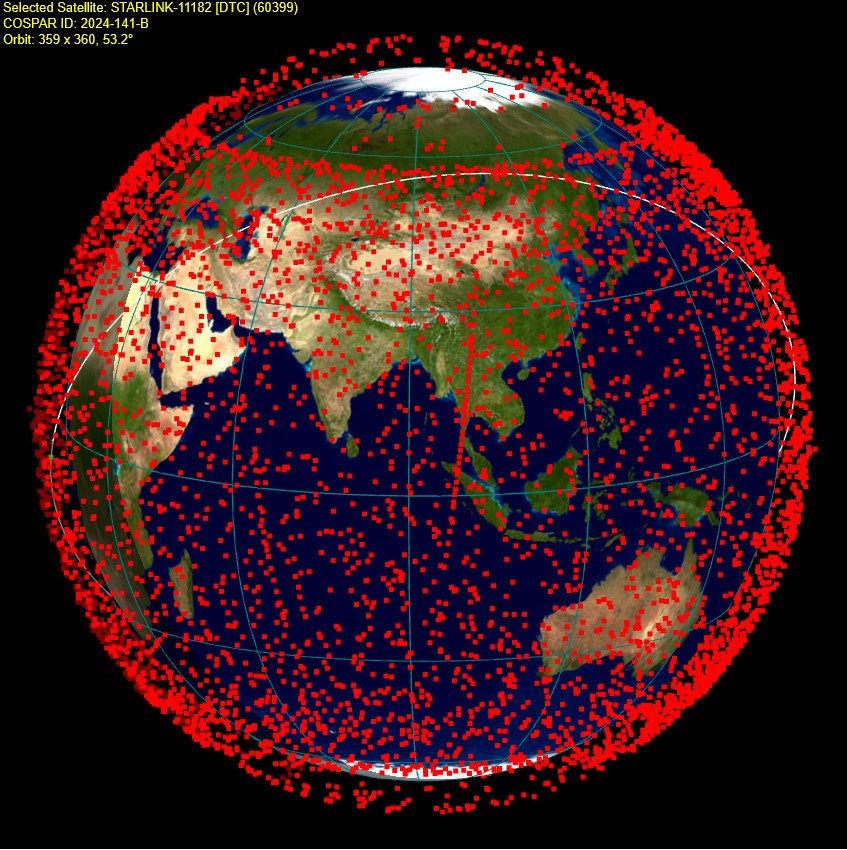
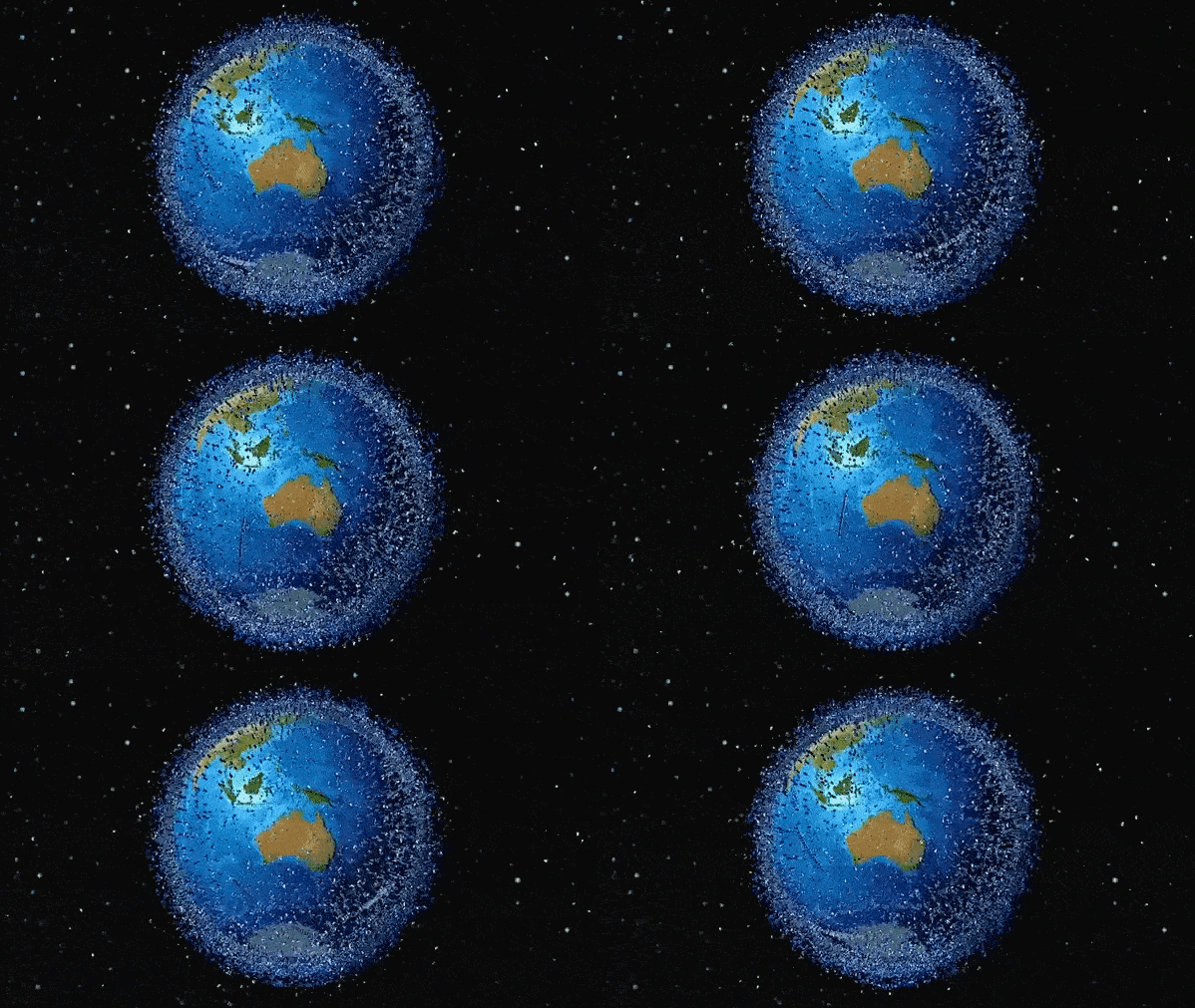
As of a couple days ago, the satellite tracking website Orbiting Now counted 13,390 satellites circling the Earth. Just a few months ago, on May 4th, that number was 12,149. Three years before that, in May of 2022, the Union of Concerned Scientists noted only 7,560 satellites in orbit. In 2019, there were only about 2,000 operational satellites spinning above us. The growth in the last several years has been extraordinary, complicated, problematic (to say the least), and just a glimpse of what’s coming. By 2040, we may have sent up a swarm of 60,000 to 100,000 of these metal devices. And what goes up…
The vast majority of these satellites are in LEO (low Earth orbit), and nearly all of them are SpaceX’s flock of small Starlink communication satellites providing space-based telecommunication services around the globe. In fact, as of this week SpaceX and Starlink control nearly 8,100 of the ~14,000 satellites circling the planet. That’s about 60% of the total, and about 75% of all satellites in LEO. Current plans are to grow their “megaconstellation” to around 42,000 satellites. They are, in other words, on track to own the skies.
Several other companies, including Amazon and a Chinese company called SpaceSail, are planning to launch their own megaconstellations, each with thousands of their own satellites meant to compete with Starlink.
For technical and regulatory reasons, each of these mini-moons has a fairly short existence in LEO. I’m used to thinking of objects in orbit as some kind of permanent miraculous technology, but these companies are building, launching, using, and then de-orbiting these things in short cycles as if they were a succession of laptop computer models. Starlink satellites have, for example, a roughly five year lifespan.
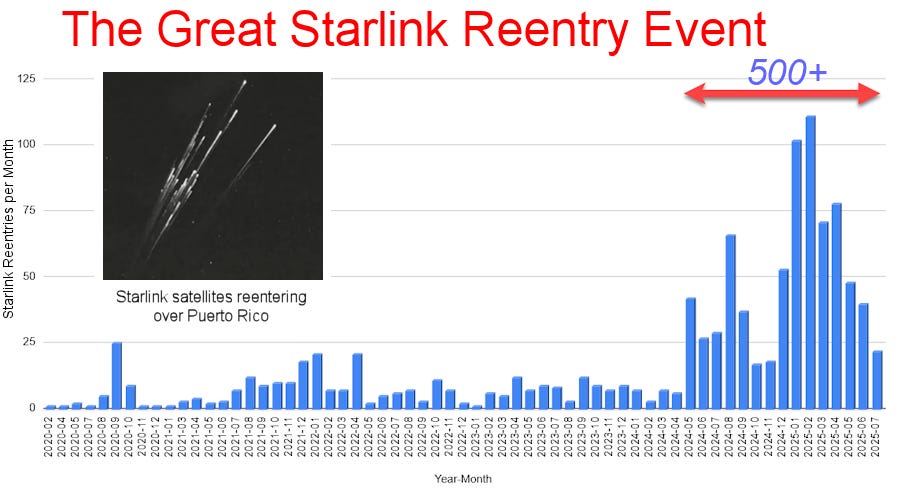
And now, as their first-generation models reach phaseout stage, the company has been aggressively retiring them at a rate of 4 or 5 per day. Between December 2024 and July 2025, nearly 530 Starlinks came burning through the atmosphere. Here’s a graphic from Spaceweather.com showing the increase:
What Goes Up Must Come Down
Why do a few hundred fireballs matter? Or, looking ahead, why would thousands of burning satellites falling from the sky every year matter? Because where there’s smoke and fire there’s chemistry.
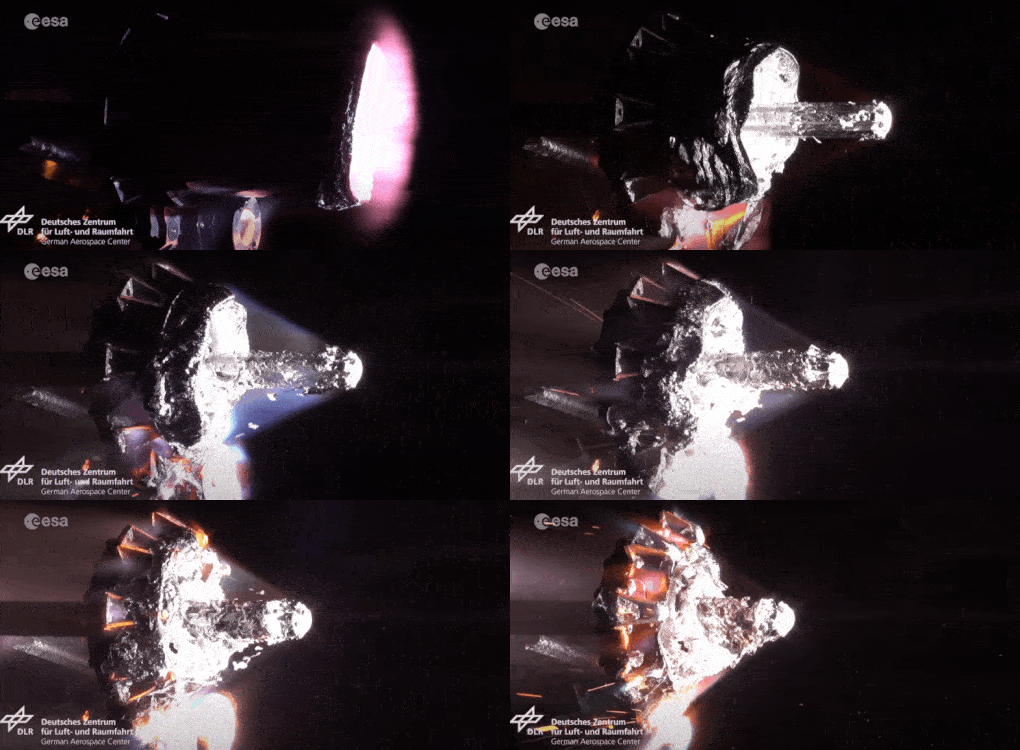
These satellites aren’t just intentionally obsolescent machines being disposed of like burning cigarette butts dropped out of a car window. They are heavy metal objects which, as they burn up during reentry through the mesosphere and stratosphere, leave behind about 66 pounds (30 kg) of aluminum oxide particles.
Aluminum oxides, as a study titled “Potential Ozone Depletion From Satellite Demise During Atmospheric Reentry in the Era of Mega-Constellations” explained, are “known catalysts for chlorine activation that depletes ozone in the stratosphere.” In other words, as you read this we’re amidst a largely unnecessary massive expansion in satellite technology that offers space-based internet access at the cost of a possibly major threat to the Earth’s ozone layer. Those aluminum oxide particles will remain in the stratosphere for decades, and we’re not doing anything about it.


As a reminder, stratospheric ozone depletion is one of nine planetary boundaries (assessed thresholds for maintaining a stable Earth system), one of three still in the green, and one of only two that aren’t getting rapidly worse. (You can see what I mean in the graphic on the right, at the top of the list of processes.)
Ozone depletion in the stratosphere is not some distant geeky irrelevancy that we in our boxed-in lives can ignore. CNET has a good overview of the SpaceX/Starlink growth phenomenon, its benefits for remote and rural internet users, and its environmental consequences, including the ozone problem:
According to the EPA, ozone depletion leads to health issues like skin cancer, cataracts and weakened immune systems, as well as reduced crop yield and disruptions in the marine food chain.
This is a oddly calm understatement of the impacts on natural systems (and thus on humans). The EPA page CNET cites is somewhat more explicit, noting that the increased exposure to UV rays from a weakened ozone layer “affects the physiological and developmental processes of plants,” reduces the survival rate of phytoplankton which “form the foundation of aquatic food webs,” and damages “early developmental stages of fish, shrimp, crab, amphibians, and other marine animals.” In other words, much of the basis for life on Earth suffers when UV light shines more intensely through a diminished ozone layer.
The dire nature of this threat is why the Montreal Protocol, a major global treaty on ozone-depleting chlorofluorocarbon (CFC) chemicals, was signed back in the 1980s, and it’s why I find this particular falling sky phenomenon so annoying. Apparently, even progress on basic functions of planetary health isn’t really progress if it obstructs the self-serving and self-aggrandizing plans of billionaires. I’m not surprised - especially in this political moment of violently disrupting the progress made on race, women’s rights, justice, and democracy - but I am annoyed. And worried.
Staring Warily at the Sky
To give Chicken Little’s critics their due, it is still unclear what the consequences will be of this transformation of stratospheric chemistry. Sure, the quantity of burned aluminum will someday outstrip the mass of burning stony meteoroids arriving from the outer solar system. And sure, as a Scientific American article explains, we know that “aluminum oxide easily catalyzes ozone’s destructive reaction with chlorine gas, which splits the ozone molecule and diminishes Earth’s UV shield.” And sure, we think that the aluminum oxide particles from each flaming reentry will be around for decades afterward, doing whatever they might do. And sure, as an astrophysicist told CNET, we know from atmospheric sampling flights that even in 2023 “10% of particle debris in the stratosphere has these weird melted pieces of metal that are suspiciously like pieces of melted spacecraft.”
For the first time in Earth history, a crucial layer of the atmosphere is being chemically altered by the burn-up of orbital machines. But maybe, as the astrophysicist noted, it won’t mean anything:
"Adding many tons of aluminum per day to the atmosphere could certainly affect the ozone layer. Right now, the research is not in," McDowell says. "It's possible the answer will be, 'Yeah, we've still got a few orders of magnitude to spare. This is not going to do anything bad.' It is also possible that the research will come back and say, 'Yeah, we're really destroying the ozone.'"
And at that point it might be too late to act.
The purpose of the Montreal Protocol was to prevent catastrophic loss of the ozone layer before it happened, but the Protocol doesn’t apply to orbital debris. The decades-long durability of the oxide particles means that they may accumulate to a dangerous extent before any meaningful policy and technical solution is devised.
The authors of the “Potential Ozone Depletion” study I cited above estimate that 16.6 tons of aluminum oxide particles entered the atmosphere from satellite burn-up in 2022, when the number of active satellites was little more than half of today’s fleet. Yet that tonnage was already an eight-fold increase over the amount in the atmosphere in 2016. Now, in the “Great Starlink Reentry Event,” SpaceX forced another 16.5 tons (15,000 kg) into the atmosphere in just six months. And they’re just getting started. The next generation of Starlink satellites will be nearly five times larger than those of the first generation.
The authors also estimate that if the various megaconstellation plans come to fruition, the recurring fire of satellite reentries will add about 360 metric tons of aluminum oxides to the atmosphere per year, approximately 640% above natural levels.
And all of this is just one of the fundamental environmental problems with the burgeoning corporate space race in low orbit. There are serious atmospheric and Earth-bound impacts from all the fiery launches, all the failed launches, all the burned rocket fuel, and the scorched and noise-blasted earth around the launch sites. There are problems for radio and optical astronomy as a blizzard of glinting blocks of electronics crisscross the sky night and day, and the likelihood of eventual collisions between falling space debris and commercial flights. There’s even the self-destructive possibility of the Kessler Syndrome, when some of the satellites in the far-too-crowded LEO region collide and create a cascade of other collisions, leaving in their wake a debris field too dense for any satellites to operate.
But I’ll set all those aside and quote Spaceweather.com about one other consequence that seems particularly relevant to those of us staring warily at the sky:
A simulation by NOAA scientists suggests that aluminum-rich space dust could heat the stratosphere and mesosphere by up to 1.5°C, and slow the southern polar vortex, potentially altering global weather patterns.
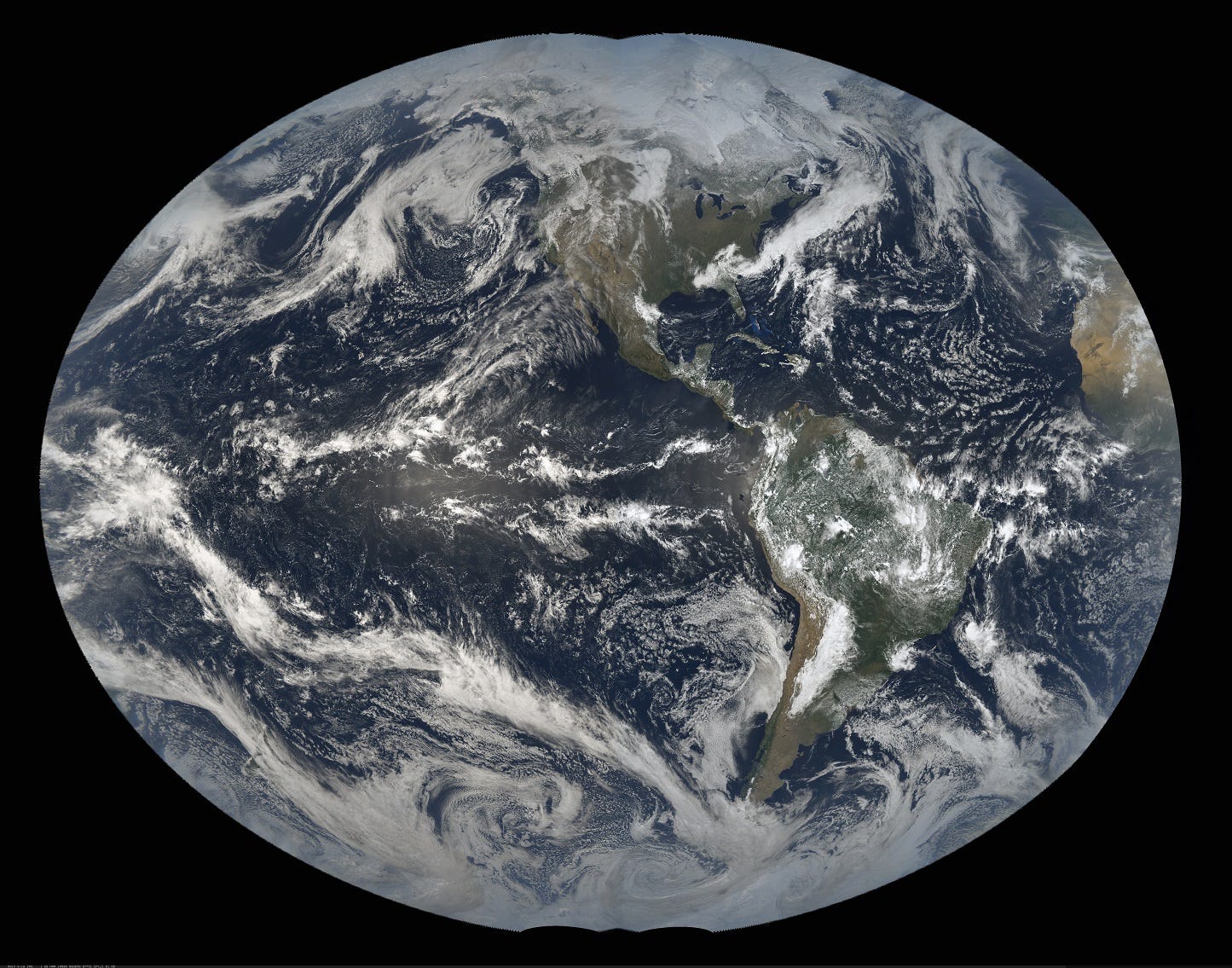
Another Unplanned Planetary Experiment
The Spaceweather.com conclusion to their report on Starlink’s massive increase in de-orbiting satellites was a fatalistic shrug:
“What happens next? We’re about to find out.”
Likewise, as an atmospheric scientist said to Scientific American about the failure to establish either scientific or regulatory certainty about the impact of a satellite-shaped atmosphere, “We’re blind but keep driving down the road.”
And that’s the infuriating idea I want to leave you with. What I’m describing this week is, in the context of the Anthropocene, just another unplanned planetary-scale experiment. I guess we’ll just put it on the untenable to-do list next to a fossil-fueled climate, acidifying oceans, 8.2 billion hungry humans, out-of-control plastics and chemical production, and global governance that refuses to properly respond to any of it. Whether you respond with panic and distress to all of this is up to you, but as I noted at the beginning, you would be excused if you did.
So often it feels like, as a culture, the folks in power are drunk-driving us into the future, confident that we’re on our own and merrily veering down empty country roads, when in fact we’re swerving down the wrong side of the highway of life as nearly every other species desperately tries to survive our high-velocity lunacy.
Or, to use a slightly less violent metaphor, in his marvelous book Ishmael Daniel Quinn suggests that modern human culture has leapt off a cliff in what it thinks is an airplane, refining the design as we fall. But it occurs to me that maybe it’s more apt to describe this culture as a bird in mid-flight, plucking out all of its feathers and proud of its nakedness, all while wondering why the ground is rushing up so quickly.
As a name for this epoch, the Anthropocene (the new human age) is as much a reckoning with our decisions as a description of what kind of planet we’re making. It is astonishing to me that we have as a culture reached a point where we can surround the Earth with satellites that allow instant communication from Pole to Pole, but it is even more astonishing to me that the forces that shape our lives have no idea what the Earth is or how to talk to it.
Thanks for sticking with me.
In other Anthropocene news:
From Bryan Pfeiffer and Chasing Nature, “The Smoke We Breathe,” a wonderful essay on what the wildfire smoke drifting down from Canada into our lives really is:
THE smoke we breathe is a soft white orchid with seductive petals. It’s an orange fritillary butterfly with mosaic wings and blue eyes. And it is the call of a sandpiper perched atop a black spruce…
We now inhale the remains of orchids and spruce, of insects and birds, and the echoes of human suffering.
From Anastassia Makarieva and Biotic Regulation and Biotic Pump, “Is Extra CO2 Good/Food for Plants?,” a long, complex, but insightful response to the argument by climate skeptics that human CO2 production is a natural boost for nature. Among other things, she addresses what she calls “ecological astigmatism — a distorted view of nature in which any increase in growth is mistaken for genuine health: the more, the better.”
From Inside Clean Energy, a good-news article on a state-wide test of a virtual power plant in California. The batteries in more than 100,000 grid-tied homes with solar/battery systems were simultaneously drawn on to supply 535 megawatts to the grid, diminishing slightly the power needed (and the fuel burned) from the state’s traditional power plants.
Just for the wonder of it… From Spaceweather.com and Communication Medicine, a new study finds that human blood pressure has a seasonal rise and fall that’s associated not with any Earthly phenomenon but with the Sun’s magnetic field. As Spaceweather.com put it, “Blood pressure rises and falls in rhythm with magnetic unrest.” Keep that in mind every time you’re outside enjoying the light.
From Reasons to Be Cheerful, a once hollowing out small town in rural Germany is now thriving and labeled the “smartest city in the world,” thanks to a thoughtful, community-focused effort to provide fully digitized services for its residents. It’s a cheerful glimpse of a possible cohesive, inclusive, and respectful future.
From the Times, the global plastics treaty is at a standstill again, as too many self-serving forces refuse to allow the treaty to rein in plastics production or to address some of the harmful chemicals they contain.
Also from the Times, plug-in solar (also known as balcony solar) is finally arriving in the U.S., but it’s early days still. Incredibly popular in Europe for homes and apartments that don’t have space for typical exterior solar panels, plug-in solar is affordable, quick to set up (sometimes in just hours), and can make a solid dent in your electricity bills.
From the Volts podcast, a conversation about Trump’s efforts to prop up the coal industry with someone who is dedicating his career to finally ending the ecologically and economically untenable use of coal-powered energy.
From Anthropocene, agricultural experiments that applied sugarcane-derived biochar to cotton fields yielded healthier soil, used less water, and reduced nitrate run-off by 87%. If these results hold up at scale, the use of biochar could go a long way to making the growing of cotton (and perhaps corn and soy) more sustainable.
One of the best pieces of writing I’ve read - brilliantly conveys the science with clarity, strategic insight and vivid metaphors that make it accessible. My personal favourite… “it feels like, as a culture, the folks in power are drunk-driving us into the future, confident that we’re on our own and merrily veering down empty country roads, when in fact we’re swerving down the wrong side of the highway of life as nearly every other species desperately tries to survive our high-velocity lunacy”. Genius.
Kessler Syndrome, here we come