
Positive and Negative
7/30/26 - PFAS in batteries

Hello everyone:
As always, please remember to scroll past the end of the essay to read some curated Anthropocene news.
Now on to this week’s writing:

World, Meet BESS
If you’ve been paying any attention in recent years to the rapid revolution in non-fossil energy production, you’ve noticed a lot more discussion about batteries. Like most people, I spent most of my life thinking of batteries as the disappointing little throwaway things I constantly replaced in my dimming flashlight, but they are now likely to reshape how humanity lives on Earth.
Solar panels and wind turbines have been the heroes (or villains) in most renewable energy stories, but behind the scenes in this moment a much faster - and more fundamental - change is occurring. We have, in the blink of a civilizational eye, begun to secure home and grid energy systems with an astonishing amount of quiet energy storage. The renewable fever dream of an eco-future will not be powered by solar and wind, but by solar and wind plus storage.
World, meet BESS: battery energy storage systems.
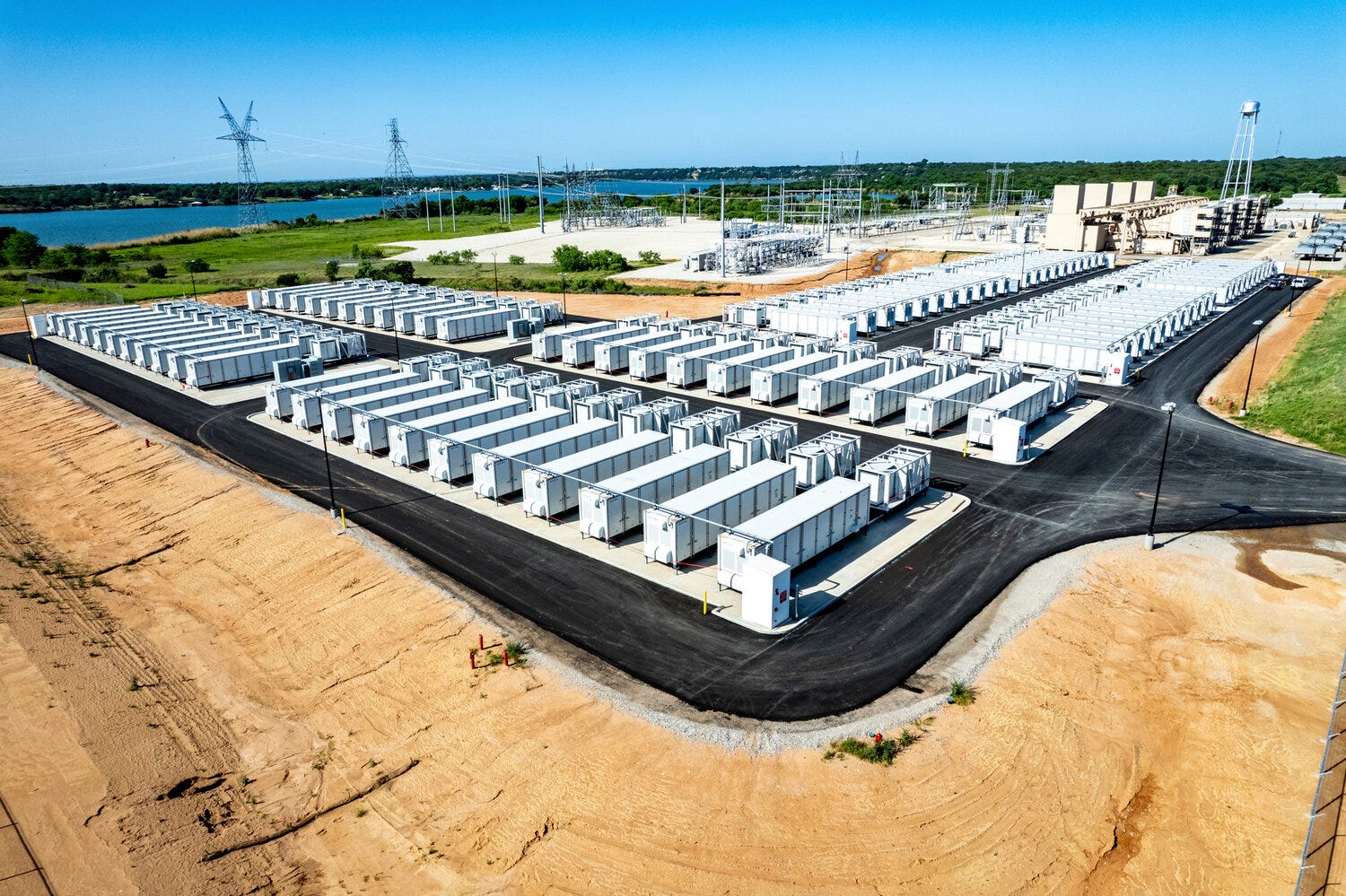
Every aspect of battery technology is improving at a breakneck pace. Ember, the renewable energy research firm, notes in an overview of the phenomenon that installation costs for large battery storage projects have dropped by 95% in just the last fifteen years, that 2025 saw more growth in installed battery storage than in the previous two years combined, and that battery technology is improving so quickly that a standard 20-ft shipping container used in large battery projects (like in the image above) now provides twice as much energy (enough to power up to 6000 homes for an hour) as they did just a few years ago.
You know it’s an energy revolution when it’s occurring in both China and Texas. In the oily fever dream of the Texas plains, wind and solar already supply 40% of the grid’s power, and battery storage has increased from less than 1 gigawatt in 2021 to nearly 22 gigawatts this year. Those batteries keep prices stable for residents, since the grid relies less on volatile methane (i.e. “natural gas”) prices and more on stored energy from solar and wind. China, meanwhile, is so far ahead on batteries (as with all things renewable) that they may as well be living in a different century. Sam Matey-Coste provided an update in a recent post of enthusiastic good-news items from The Weekly Anthropocene:
Grid-scale batteries are spreading incredibly fast as a vital clean reliable grid-stabilizing power source around the world….and even faster in China specifically. In 2025, total cumulative lithium-ion battery storage capacity in China hit 140.2 gigawatts of capacity, exceeding the rest of the planet combined at 132.1 GW. For context, that’s up from just 2.8 GW of batteries in China and 10.2 in the rest of the world in 2020. Renewables plus batteries are transforming human life on Earth!
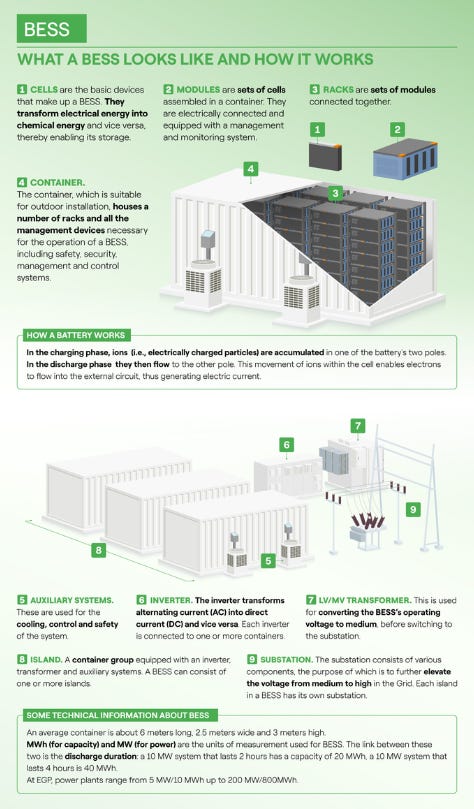
Here’s a good, if boring, BESS graphic to help you picture the battery storage revolution:
Silos for Sunshine
Ember describes battery storage as “a Swiss army knife,” “the backbone of a resilient renewable energy system,” and as
The ultimate clean flexibility tool for making clean electricity available when it is needed most, while keeping power grids stable and secure.
Grid-scale batteries turn solar and wind into steady power sources, eliminating the complaint from fossil fuel advocates that renewables cannot be relied upon. As “silos for sunshine,” batteries provide “an agricultural revolution for energy.” We no longer need to forage around the globe for fossil fuels at great expense; instead, we can farm energy right where we live and store it in our battery silos. As Ember puts it,
Much as granaries and refrigeration transformed food markets, storage will turn electricity from perishable to persistent, unlocking a new era of energy abundance.
It is, I think, impossible to overstate how pervasive rechargeable batteries will become in society. Already, they quietly power our digital lives, which (we should admit) make up much of actual lives. We’re on the threshold of the “batterisation of everything,” in which batteries will underpin not just every aspect of the massive grid of electrical power lines that tie civilization together, but also every corner of our homes, offices, and vehicles. They’re already in our cars, pockets, and ears. They power quiet lawnmowers and tools. They’re finding their way into “smart” appliances, which include stoves, fridges, washing machines, heat pumps, and much more.
Taken together, all these batteries are building toward a dream in which a distributed grid of homes and businesses exist as power generators as well as power users. Already today, there are grid operators paying customers for the right to draw energy from our home batteries, appliances, and EVs as needed. In this scenario, our homes are no longer just passive recipients of some polluting, distant, centralized energy source. We’re nodes in a give-and-take ecology of energy.
As wondrous as all this is - for reducing fossil fuel harms to Earth and bodies - it is also problematic. I’m not referring to the catastrophic mining for all those minerals that make up the batteries - which includes child labor, deforestation, and pollution - because a) that catastrophe is far smaller than the extraction of fossil fuels, and b) new battery tech is coming that eliminates the worst of that mining. The dream of a circular battery economy is possible.
No, I’m speaking of a problem that is too rarely discussed: the PFAS that haunts battery chemistry.
Clean Tech, Dirty Chemistry
Any problem-solver knows that every solution breeds its own problems, and in the Anthropocene any solution to a problem for more than 8 billion people risks creating transformative (if not dire) consequences for the Earth. There’s simply no escaping that. To mix my metaphors, we’re the elephant trying to change directions in the china shop.
The vast collection of PFAS (per- and polyfluoroalkyl substances) “forever chemicals” provide solutions to myriad industrial problems, but have become a primary ecological nightmare for us, for future generations, and for life on Earth.
The poisoning of both bodies and environments is ubiquitous and worsening. It’s impossible to escape. Your blood and mine are rife with it, and rain isn’t safe to drink. Everywhere on Earth, wildlife tests positive too. The chemicals exist unidentified in thousands of consumer products - including food packaging - and in nearly all public water supplies, and are passed from soil to food and from mother to fetus.
As for the long list of human health problems, here’s a brief summary from a public health expert at Yale:
PFAS are linked to various cancers such as kidney, testicular, and liver cancer, as well as liver toxicity. There is a rising incidence of early-onset cancers, like colon and liver cancer, in younger individuals, potentially due to developmental exposure. Developmental and reproductive effects of PFAS include low birth weight, accelerated puberty, reduced fertility, and pregnancy-induced hypertension, with possible epigenetic changes that might contribute to early-onset cancers. PFAS also impair the immune system, reducing vaccine effectiveness and potentially increasing susceptibility to infections like COVID-19. Additionally, PFAS exposure is linked to various metabolic effects such as obesity, type 2 diabetes, cardiovascular disease, reduced kidney function, high cholesterol, colitis, and neurodegenerative issues in children.
There is no safe level of PFAS exposure. There’s evidence of harm to animal nervous systems from just a few parts per trillion (ppt), which is a few drops of PFAS spread across 20 Olympic-sized swimming pools. Any officially established safe level is merely another example of government allowing a citizen-poisoning industry to exist. I could, and should, write you an essay on how a few generations of petrochemical industry executives (and some of their regulators) should be put on trial for crimes against nature and humanity. Their behavior, to this day, has been violently selfish and destructive.
Their chemicals persist in flesh and soil for untold years, where they continue to accumulate because of ongoing and increasing exposure from the many thousands of PFAS chemicals the shameless industry continues to create and sell. This is as true for the health of fish and polar bears and entire ecosystems as it is for your kids and grandkids.
So it’s no surprise, I suppose, that PFAS chemicals are in batteries. They’re extraordinarily useful chemicals, if you ignore their dystopian pervasive toxicity. They’re resistant to heat, water, and oil. A battery is a chemical reaction in a container, and a rechargeable battery is a chemical reaction that needs to work well for thousands of charges over many years. PFAS chemicals help make that happen by making the batteries more stable, durable, and efficient. There’s a quick summary of how that works here.
Positive and Negative
I first heard about this topic in 2024. My saved articles from then include a comprehensive investigative piece from Mother Jones, in collaboration with The Examination, The Post and Courier, Columbia Journalism Investigations, and RTBF. (It’s an excellent article to read if you want to learn to hate the chemical industry.) Then, as now, new generations of lithium-ion batteries (LiBs) dominate the “clean energy” market, whether storing solar power from roof-top panels, quietly accelerating your EV, or sitting en masse in shipping containers to back up the grid. And, as it turns out, a world powered by standard lithium-ion batteries is a world more polluted with PFAS. LiBs, and the waste created in their production, are full of these chemicals, particularly PVDF (polyvinylidene fluoride) and bis-FASIs (bis-perfluoroalkyl sulfonimides).
As the Mother Jones article made clear, decades of contamination of groundwater, soil, and communities around PFAS manufacturing sites demonstrates the nexus between cruel companies, poor regulation, and a potent class of chemicals. There’s little reason to expect a much better result from this new global source of PFAS production and contamination. Neither the chemistry nor the corporate behavior has improved. There will be release of PFAS into air and water from manufacturing of the chemicals and the batteries, from batteries damaged during their working life, and from the final disposal or recycling process.
This is already happening at a global scale, as the battery revolution takes off. Nearly all of those grid-scale BESS systems are built with LiBs, as are nearly all EV batteries. Most are at the very beginning of their working life, but I’m not convinced we’ll have a safe way to handle them when they need to be replaced. As it stands, research demonstrates that these chemicals are released during the standard high-temperature lithium-ion battery recycling process, but that even higher temperatures might destroy the PFAS. Most LiBs, though, are still being thrown away rather than recycled.
Meanwhile, the authors of a 2024 study in Nature sampled air, water, snow, and soils near PFAS manufacturing plants and landfills in Minnesota, Kentucky, Belgium, and France, and found bis-FASIs at levels a thousand times greater than established “safe levels” for similar chemicals. The study’s conclusion warned that the tradeoffs of the clean energy revolution should not include “a classic case of regrettable substitution” of one global environmental harm for another:
Rigorous lifecycle assessments are needed to ensure that reduced CO2 emissions are not outweighed by increasing global releases of persistent organic pollutants. Failure to do so may lead to a classic case of regrettable substitution and a missed opportunity to maximize sustainability and improve environmental health.
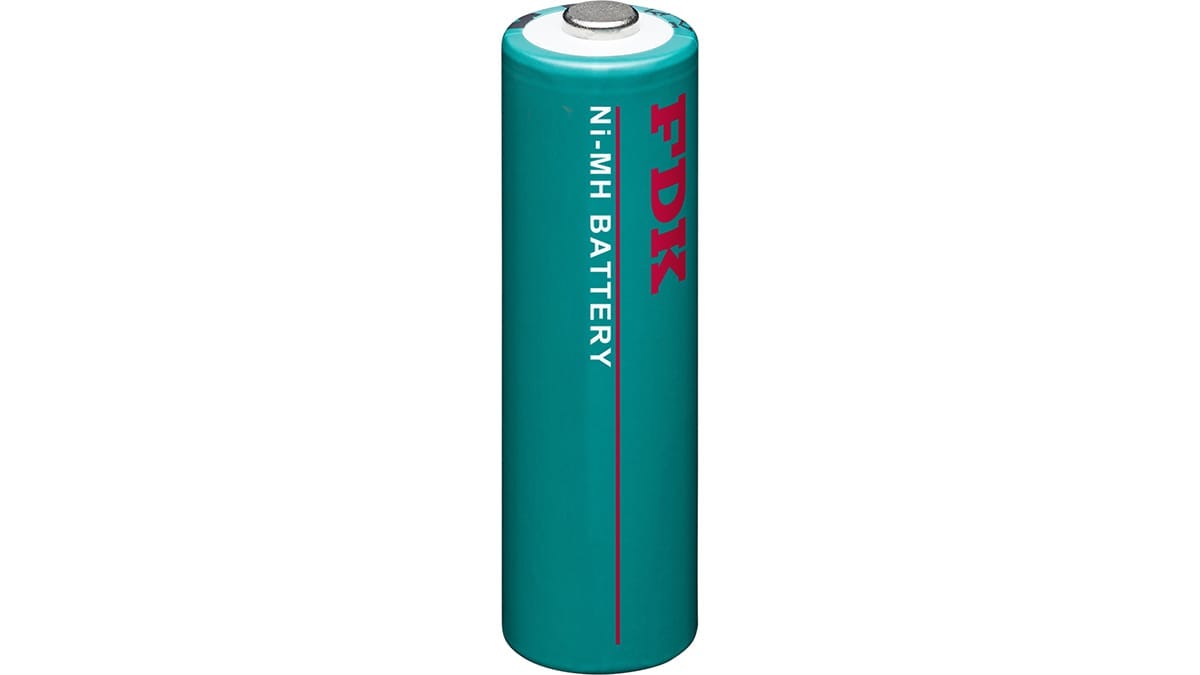
A Cleaner, Quieter Future is Coming - Eventually
There’s a part of me that didn’t want to write this piece. Batteries are becoming such a remarkable and important part of the renewable energy revolution, and it’s nice to imagine them as a quiet hero in what so often feels like an unwinnable war. But all solutions are complicated, especially when the problem being solved is global and systemic. Revolutions always offer a sales pitch that’s too good to be true, requiring a lot of quiet fixes along the way.
The good news is that some quiet fixes are on the horizon. The first new PFAS-free batteries are being developed and sold. A U.S. company has innovated a new electrode manufacturing process that apparently eliminates toxic solvents and PFAS chemistry, improves energy density and performance, reduces energy consumption by 82%, and costs far less. A Canadian company is developing a PFAS-free and cobalt-free solid state battery. Sodium-ion chemistry may replace lithium-ion in grid-scale energy storage, reducing the problems of lithium mining and PFAS usage at the same time. And there’s so much more happening with battery technology; new advances seem to arrive by the week.
Regulations have a role to play, but are not yet playing it. Even where stricter PFAS regulations for consumer products have been written (like here in Maine) or are planned (in Europe), they include exemptions for any batteries whose use is unavoidable. For now, given the lack of alternatives scaled up in the marketplace, this includes EVs and grid-scale battery storage systems.
The bad news is that even if PFAS-free batteries start to take over the market in, say, ten years, that’s a decade too long. The growth of battery production is so incredibly fast that the hundreds of gigawatts of PFAS-laden storage being built each year will be locked in for a long time. We’ll have to figure out how to recycle those tainted batteries anyway. Worse, I haven’t figured out whether Chinese battery companies have prioritized PFAS-free innovation, and they represent most of the world’s battery production.
Despite the scale of the PFAS problem across societies, and despite the scale of battery technology’s growth (and promise of a future without fossil fuels), both phenomena seem to be flying under the radar. Which is why I’ve written this piece. We need more conversation about both, and more pressure applied to regulators, who should be setting policy that suppresses PFAS production, cleans up battery chemistry, and encourages manufacturers of consumer products to advertise their batteries (and other goods) as proudly PFAS-free. We should at least be able to do a little smart shopping to choose an EV or phone that doesn’t contain these chemicals.
Nevertheless, the long-term outlook is pretty bright. Innovations should eventually create a new standard of cleaner batteries that can be recycled cheaply and easily. That, in turn, could lead to the circular battery economy in which mineral mining is minimized and the global energy system is far less extractive.
What this thing we call civilization does with its energy is bad enough. I look forward to the day when at least the energy source is brighter than a dimming flashlight and as wise as a leaf.

Thanks for sticking with me.
In other Anthropocene news:
From Emergence, “A Glorian is a Moment of Grace,” a recorded interview with Terry Tempest Williams about her new book. I’ve only started to read the transcript, but am eager to read more, not least because she describes the magic of watching an ant carry a flower petal across the desert and then says this:
When our attention is fused with another being—it can be a plant, animal, insect, a moment, a memory—I think it’s when our attention is seized. And I do believe that a Glorian is a moment of grace, unearned, unexpected, unwarranted. It arrives. And we are enveloped.
From Grist, “Killing trees to save the forest,” about a long-running experiment by the Nature Conservancy in Vermont to breed American elms that are resistant to the deadly Dutch elm disease that nearly wiped out the species over the last century. The stately, tall, vase-shaped elms are now famous for lining the streets of 19th and 20th century America, but they had vital ecological roles to play too, and this long-term project may someday allow them to thrive again in those roles.
From Yale e360, “Wastelands No More: India Charts a Future for its Grasslands,” a hopeful story of the world’s most populous nation beginning to recognize that grasslands are vital for preserving biodiversity, and developing a plan to protect and revitalize them.
Also from Yale e360, small controlled burns in California’s giant sequoia forests have saved nearly two thousand of the magnificent trees from recent intense forest fires.
Two stories of ecological consequence from the war against Iran: First, from LiveScience, the 1,000+ tanker/cargo ships idling for months in the Gulf of Hormuz, gathering tons of biological growth on their hulls, pose a “superspreader” invasive species threat once they leave the gulf. And second, from Time, “How the Iran War Worsens the Climate Crisis,” lays out the multiple ways the war makes life harder for people in a region already being hit hard by a warming world. As another article about the war noted, “Every missile strike is another downpayment on a hotter, more unstable planet, and none of it makes anyone safer.”
From Rob Lewis and The Climate According to Life, “Is the Living Climate a Poem?,” a lyrical exploration of how our understanding of the Earth’s climate feels like the articulation of an elegant and beautiful poem.
From Anthropocene, some hopeful research suggests a strategy to remove PFAS contamination from farmland using hemp, rock dust, and biochar.
Thanks for sharing! I used to study PFAS in sea turtles, killer whales, and black crowned night herons. Their ubiquity is astounding.
Definitely. It made its way into the Saturday lunchtime discussions in this household, in any case. Thanks again.