
Over Winter Fields
3/12/26 - Emptying out and filling up

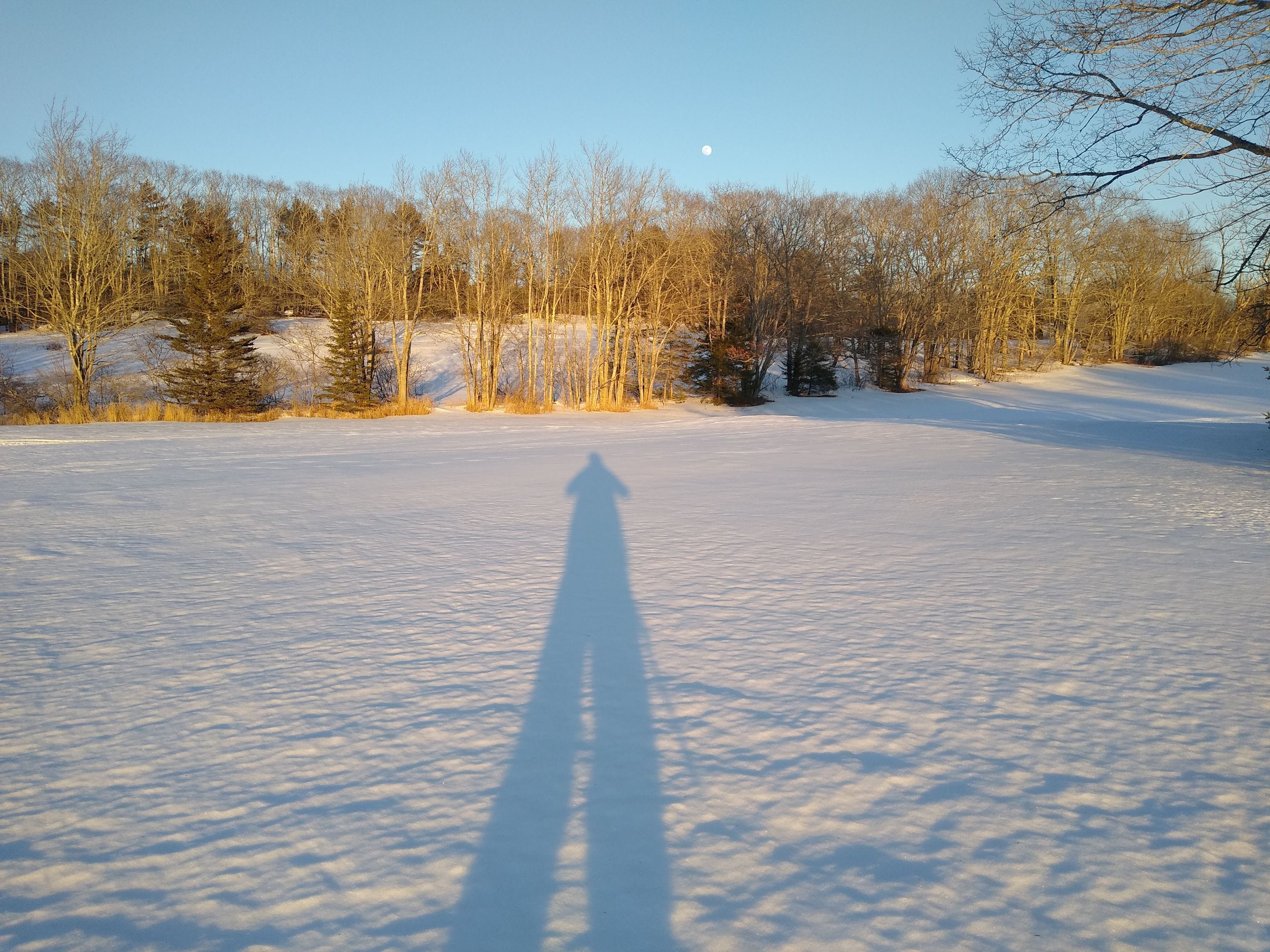
Hello everyone:
I’ve been writing quite a bit about the built world lately. This week, I clear my head on a slow walk through the real world, and return to what this writing is meant to honor.
As always, please remember to scroll past the end of the essay to read some curated Anthropocene news.
Now on to this week’s writing:

Here in the north country, the end of winter is coming. Daylight is a candle with a lengthening wick, and its warm light pulls back the deep blanket of snow to let the first green thoughts emerge. On the forest floor, microcosms of moss blink, then begin again the work of ages. The enduring hearts of what we call ephemerals - bloodroot, trillium, and trout lily among them - stir within the living soil, murmuring beneath the soft ticker tape of last year’s leaves. In fields, even before the husks of last summer’s grasses and flowers are fully revealed, snow-filtered light reignites the innumerable engines of the world beneath our feet.
Everywhere, life moves upward and outward like softly growing applause for the Sun.
The thermogenic miracle of skunk cabbage impatiently burns its way up through the snow. Nearby, the cryogenic miracles of wood frogs thaw and prepare to call softly from icy pools. Red-winged blackbirds and woodcocks, among the first to wing their way north, arrive to sing amid sun-warmed slush.
In the weeks ahead, hundreds of millions of warblers - each the weight of a few pennies - and other bold handfuls of feathers will trace Earth’s magnetic field through the starlit skies of North America, calling out to each other in what Bill Davison celebrates as “the ongoing murmur of a world you belong to.” No less ardent, and under rain that falls beneath the same stars, rarely seen salamanders will emerge to follow their damp passions on slow, epic, soundless half-mile plods from dark duff to vernal pool.
Mating, breeding, singing: Spring fulfills the promise that death makes to life, and awakens the promise that life makes to death. Our singing is part of a much larger song.
But for some of us, spring can come too soon. Winter offers clarity and joy as well as difficulty, if we’re lucky enough not to suffer too much. Cold, ice, snow, and darkness test the spirit and thin the herd, but it is also a time of profound beauty. With apologies, then, to those for whom spring cannot come soon enough, I’m here to offer an ode to winter in its time of passing.


Winter, I’ve long thought, teaches us the richness that comes with emptiness. Indoors, we treasure the light and warmth that shield us from the cold and dark. Outdoors, we find ourselves silhouetted like the trees and winter weeds against the blank wonder of snow, and so more easily feel the depth of our belonging.
This water that falls like feathers reorients the world, waits with us here above ground in a cold bright stillness that distills complexity into a map of silence. That silence around us provides fellowship for the silence within us.
I go out into winter to be emptied out and filled up. This is true of any walk in any season, I think, because people have evolved over uncounted generations to walk through forest and field, mountain and coastline, desert and wetland, and now cities, with minds that ease anxiety with movement. But winter intensifies that gift for me, makes it more elegant and distinct, as my boots plunge through snow with the focused simplicity of breath in, breath out.
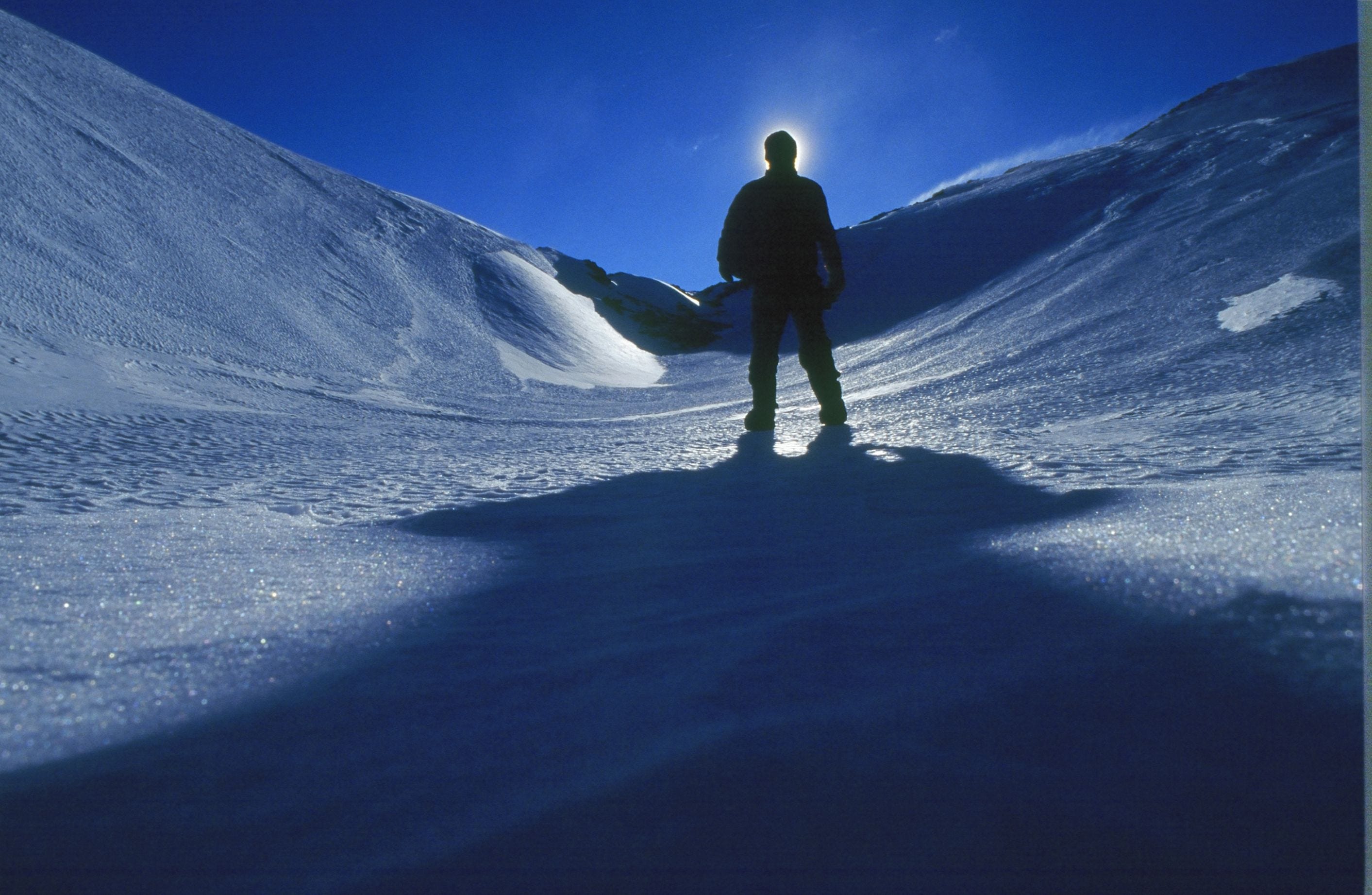
It’s not a surprise, I suppose, that after spending much of my young adulthood bouncing between Maine and Antarctica, I feel at home in winter. But that decade in Antarctica’s permanent winter was lit by a 24-hour summer sun, and so I have to confess to preferring my cold-weather walking meditations to be well-lit. To no avail. A Maine winter forces us to be our own candles in the darkness.
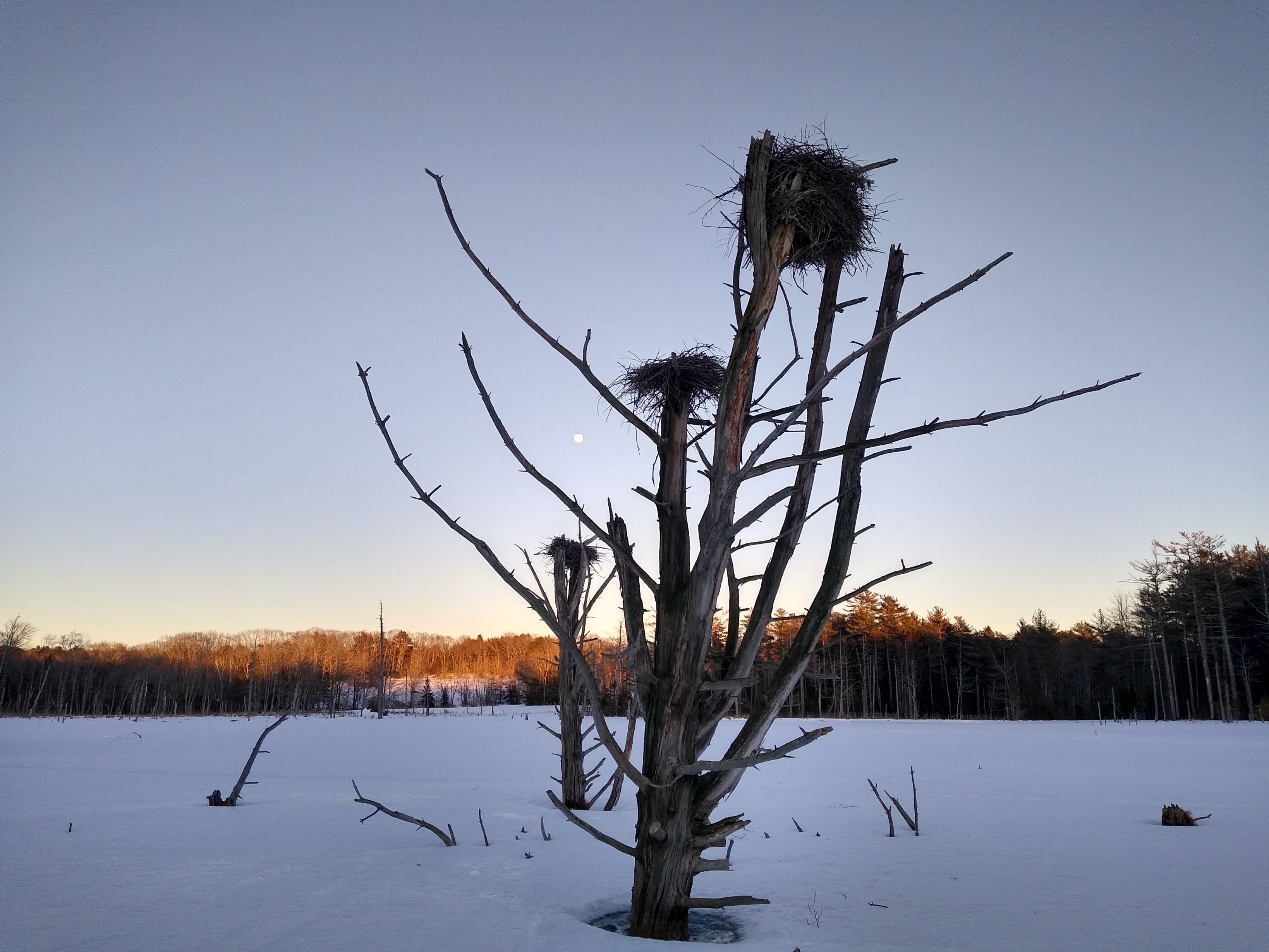
In one sense, I don’t mind the long hours of night: I’m a recalcitrant night owl, and so the flood of darkness allows more owlish behavior. But come December, the days begin to feel as ephemeral as a blossoming starflower. If I sleep in - and I do - I miss out.
My favorite walks this winter - always in the dusk of late afternoon - have been a handful of mile-long bushwhacking trudges from the house here. I pass through a drift-filled forest, around an alder swamp, across the ice of a bog laced with otter trails, then along a cheerful little outlet stream before it broadens into a large wetland with a massive beaver lodge in a pond whose dead trees host a dozen great blue heron nests.
The deep snow and the necklace of frozen wetlands remind me that winter is a revelation about the physics behind biology. Flora and fauna are only characters in the story of a planet spinning and tilting in its orbit. Water, vapor, snow, ice: The fate of water, in this story of flux and flow, defines the fate of its characters. I’ve always felt that following a stream is a profound narrative, because it is both ordinary and a path to joy. And a winter following feels more profound, in part because the starkness of winter lays bare the bones of reality, and in part because I get to walk on water.
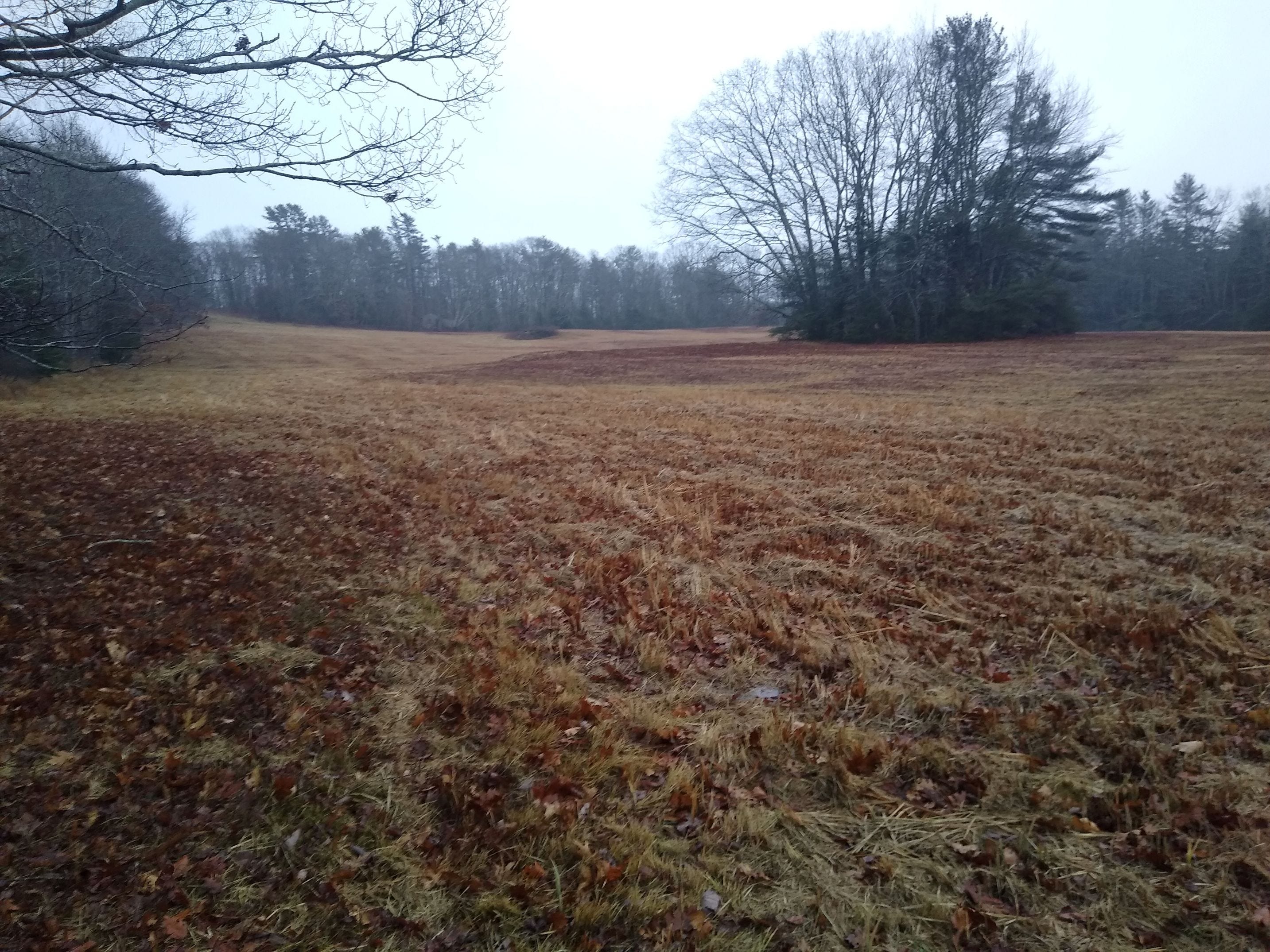
The beaver/heron pond lies at the bottom of a large and noble sloping field, surrounded by undeveloped forest and overseen by an old neglected farmhouse perched atop the hill. An old colonial road, now a forest path, runs nearby. There’s an island of pine, maple, and birch in the lower field, standing tall in what was recently a thick blanket of snow.
As spring awakens and throws aside winter’s white quilt, the field is moist and golden in the light. Frost in the earth breaks, softens, then melts into groundwater. The feathers of snow dissolve to wet and whet the appetites of soil, and the field’s albedo shifts from the sharp reflections of winter to the warm embrace of spring.


I love walking, skiing, and snowshoeing through forest, keeping company with trees and seeing in the snow-reflected light the extraordinary elegance of lichens mapped onto their trunks. I love how a winter forest provides step-by-step evidence of the paths of other lives - deer, coyote, turkey, squirrel, porcupine, bobcat, otter, fisher, and so many others - and how our tracks are woven into theirs. I love tracing and crossing streams, and walking across the ice of usually impassable bogs and swamps.
I love how the dance of life and death play out in a winter forest, how the elegant dark bones of trees and shrubs shape the northern story of survival, rising out of the white starkness to feed the birds and acknowledge the Sun. Their buds, in place since the fall, were built on last summer’s light and are dedicated to the light that’s coming. That’s a message of endurance we would all do well to heed.
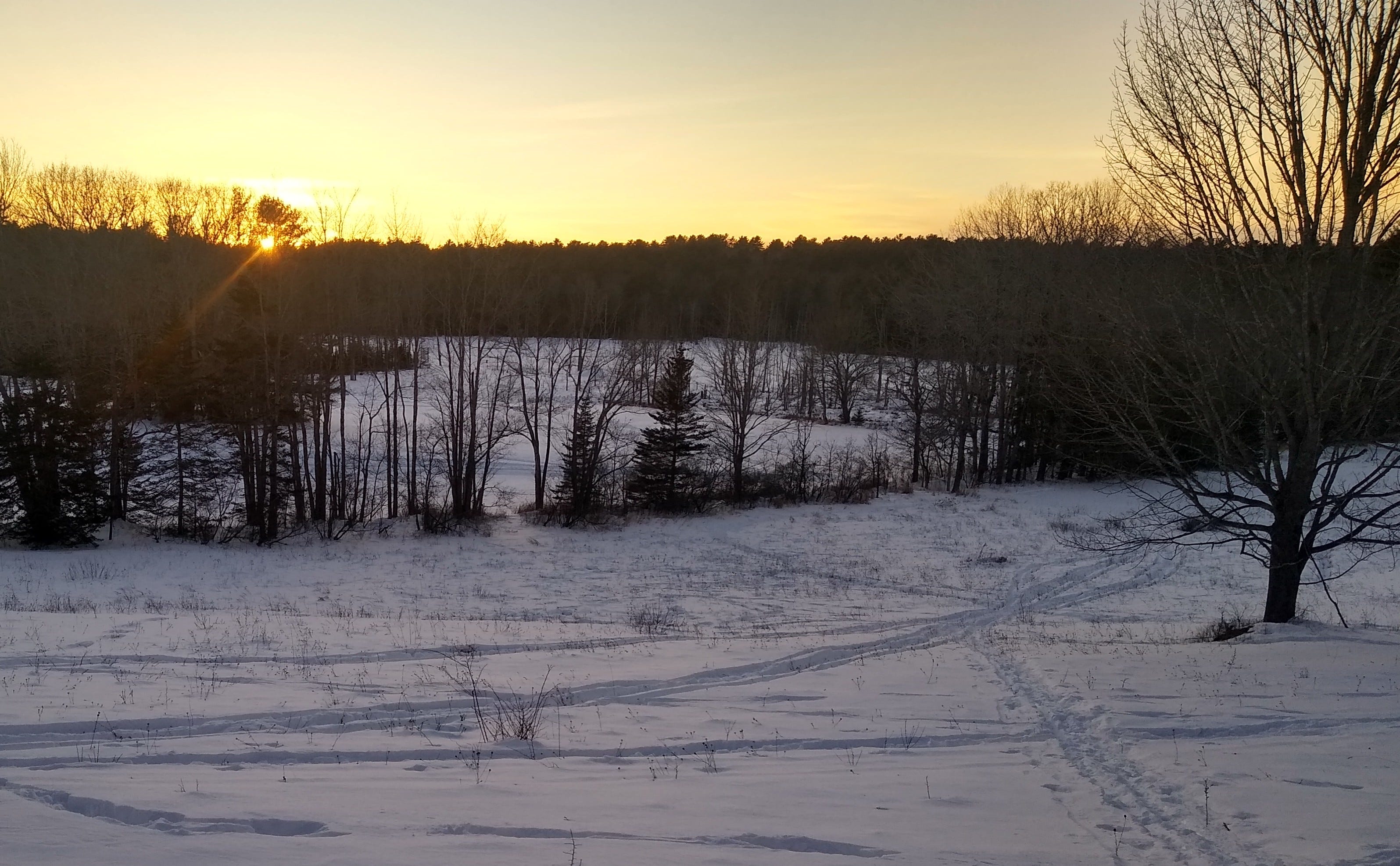
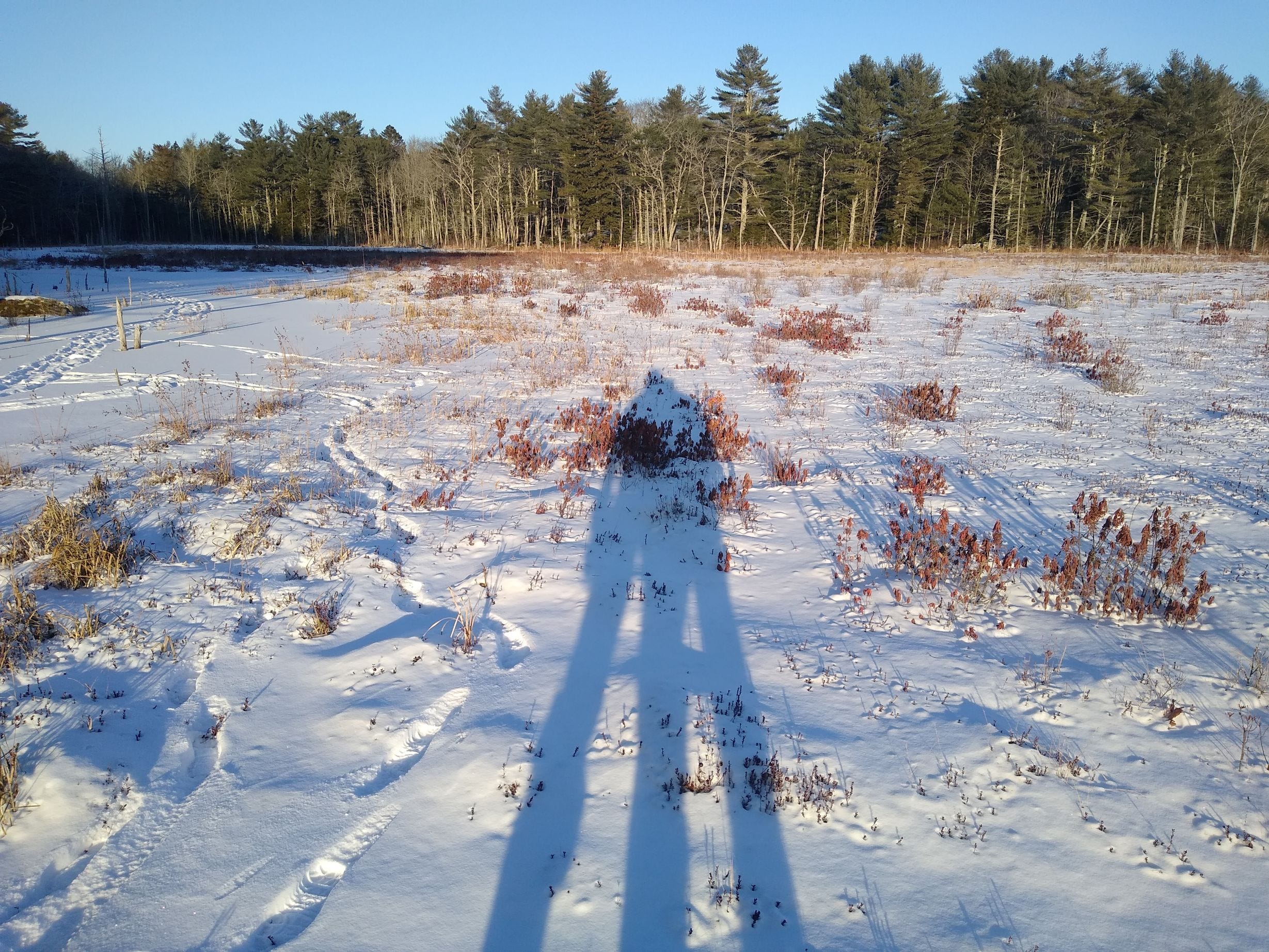
But it’s the winter fields that I keep coming back to. There’s nothing like emerging out of the dendritic forest landscape - trees and shrubs sending their woody arteries and capillaries toward the sky - into the wide open simplicity of a snowy field. Perhaps it’s the ancient human desire for a clear view over the savanna. Perhaps it’s the part of me that fell in love with the vast emptiness of Antarctica, where I found the astonishing nature behind nature’s green curtain. Or perhaps it’s my attachment to the promise of a blank page, knowing that winter’s harshness will always give way to the beautiful complexity of life.
Here in Maine, where a field always wants to be forest, an old farm field is both the footprint of destruction - trees felled or burned, perhaps a century or more ago - and a resilient constellation of life. No longer pasture, but still mowed every year or so, the field I’ve made my short pilgrimages to this winter is a beautiful artifact. Beneath the snow is an intricate tangle of last year’s grasses, sedges, and flowers. At our previous home, Heather and I documented 93 flowering plants in a similar but smaller field. The more details of life we saw in that field, the more we realized we weren’t seeing, and would never see. A field is a tattered scrap of fabric that speaks to the wholecloth that contains us all.
A winter field, then, is both blank page and a message about what comes next. Revelation is guaranteed - that’s the nature of sunlight - but what is revealed depends entirely on our willingness to look, and to see, and to act in a way that best serves the artifact we have made of the Earth.
So, yes, the end of winter is coming, and coming quickly. I don’t dread it as much as Heather does, but spring brings the to-do lists of garden and yard, the prospect of summer heat, and the new ubiquity of disease-bearing ticks, who have completely changed how we relate to the good green world. Heather’s perfect year would consist mostly of fall and winter, with a palate cleanser of spring and just a brief taste of summer. Her latest post at her notebook of nature songs, A Nest of Songs, offers her own beautiful ode to winter, “Cradled in the Quiet.”
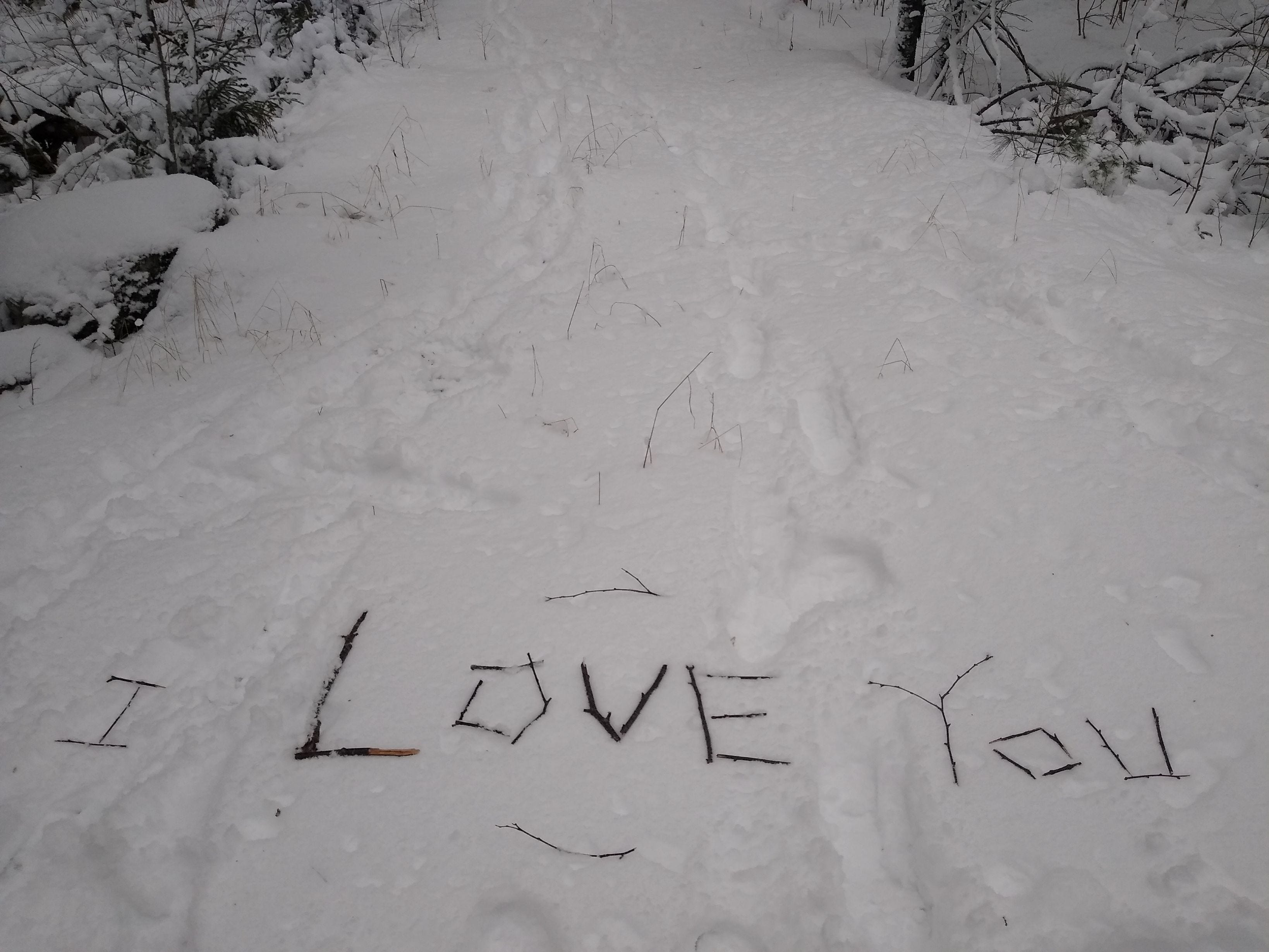
And that reminds me of the last thing I should say about my passage through winter into spring. I am incredibly lucky to share that passage with a friend who happens to be my beautiful wife, and who is more devoted than me to being out in field and forest to see what needs to be seen, and to share what needs to be shared. Heather maps the lichen and counts the flowers; she tracks the bobcat and coyote and kneels before the deer bed to find signs of the fawn; and she shares what she learns with whoever she can.
She is her own candle, and I’m fortunate to live in its light.
Thanks for sticking with me.
In other Anthropocene news:
As cited above, a wonderful photoessay from Bill Davison and Easy By Nature, “Stars Talking to Stars,” about how awareness of bird migration leads to greater awareness of what life is and what life needs. Bill’s writing just keeps getting more beautiful:
Dissolution is not death; it is flight. We are called to join a river of awakening.
We are drowning in information but starving for awareness.
From Chloe Hope and Death & Birds, “Untangling,” yet another incredibly beautiful short personal essay about, yes, death and birds, but really about all that is most real about being alive. Read this essay, see the photo at its end of the kinship between her young self and a Harris hawk, then subscribe to read everything else Chloe has written.
From David E. Perry and In the Garden of His Imagination, “Warm, Their Gathered Light,” a beautiful short photo-ode to swamp lanterns, Western relatives to both skunk cabbage and jack-in-the-pulpits:
Deep in the piney woods of late, in places low and damp, mysterious light gatherers swell and grow, reaching bravely upward, voiceless and steady, collecting fuel: raindrops, and fog dew, sunbeams and moonbeams, cloud glow and wisps of light from every imagining, even occasionally, stray bits from an early spring rainbow.
From Aeon, a sweet and very short animated video by Aboriginal Australian artist Betty Conway, illustrating the joys of a family after rain arrives in the dry landscape of the Northern Territory.
From the Times, the Nature Record, a massive nearly-900-page report on the state of nature in the U.S., was nearing publication when the Trump administration axed it. Nonetheless, the large team of scientists persisted, and have now released a draft. The story it tells is similar to the story of its release: grim, but dotted with hope:
Many of the preliminary findings are grim: Freshwater ecosystems across the country are in crisis, “overdrawn, polluted, fragmented and invaded.” Marine and terrestrial ecosystems are degraded, with reduced biodiversity. An estimated 34 percent of plant species and 40 percent of animal species are at risk of extinction.
Human pressures on nature are eroding the necessities it gives us, such as clean water, food, health, livelihoods and protection from storms and fire. But there is hope, and the authors emphasized the ability to chart a new course.
“The future is not fixed,” said Phillip Levin, who directed the assessment both under the government and since. “Conservation, restoration and renewed connections between people and nature can improve ecosystem health and strengthen community resilience.”
From Bulletin of the Atomic Scientists, an eye-opening long-form article on what’s really been happening in Japan to the communities poisoned by the Fukushima nuclear disaster 15 years ago. The government claims progress and clean-up where the citizens document a much more difficult reality.
Some of Japan’s efforts to revive the area have been successful. Other measures have created injustices and stigma. The lived experience of people resettling the evacuation zone reveals an ongoing disaster at Fukushima—a disaster that is not well known in Japan or the rest of the world.
From The Conversation, an explainer essay by one of the researchers behind a new study that found that worsening bird species’ losses in North America are associated with intensive agriculture:
Modern agriculture transforms landscapes. Large cropland areas replace diverse habitats. Herbicides and pesticides used on farms reduce weeds and insects that many bird species depend on for food. Heavy machinery and reduced habitat diversity can limit nesting opportunities.
Here’s another of my frequent reminders for you to consider subscribing to both The Weekly Anthropocene from Sam Matey-Coste and Global Nature Beat from Mike Shanahan. Both Sam and Mike provide extraordinary resources, having cast very wide nets for news on the research and politics of biodiversity (Mike) and positive energy and wildlife stories (Sam). Sam’s latest is here, and Mike’s is here.
From Quartz, the recycling industry is betting heavily on the ability of machine learning (i.s. “AI”) to make the recycling of everything from electronics to clothing more manageable and profitable. So much material is wasted because it’s difficult to sort and process. It is possible that one of the benefits of “AI” is a cleaner, more rational, waste management system. We’ll see.
From Reasons to be Cheerful and NPR, two updates on the exciting prospect of plug-in solar (a.k.a. balcony solar) here in the U.S. Plug-in solar is a plug-and-play device consisting of a small solar array that you simply set up and plug into your house. Nor permits necessary, and it typically pays for itself in a couple years as it cuts a sizeable amount of your electricity bill every month. Already very popular in Germany and elsewhere in Europe, so far only Utah has passed legislation allowing it, but 28 states have bills in the queue. Reasons to be Cheerful provides an overview, and NPR reports on utility efforts to slow the roll-out.
Writing to you from Tucson, where it's supposed to be 90 degrees day, I am so jealous. And, appreciative of your splendid paean to winter.
Thank you. Starting my day with a hot coffee and your essay allows me to ease into the day reflecting on what is important and how I used to enjoy those long solitary winter walks through the Vermont landscape. I just finished an energetic conversation with my friend,partner and spouse who starts her days deep in the news, local and beyond, and what a contrast it is to setting the tone of the day. I am content with my approach. My only complaint is that if I allow myself to follow the path you laid to so much other good and meaningful writing I would still be sitting here at dusk with a cup of cold dregs. But thank you still.