
Reflecting Badly
5/14/26 - The foolish plan to put mirrors in space

Hello everyone:
As always, please remember to scroll past the end of the essay to read some curated Anthropocene news.
Now on to this week’s writing:

We Lose the World Too
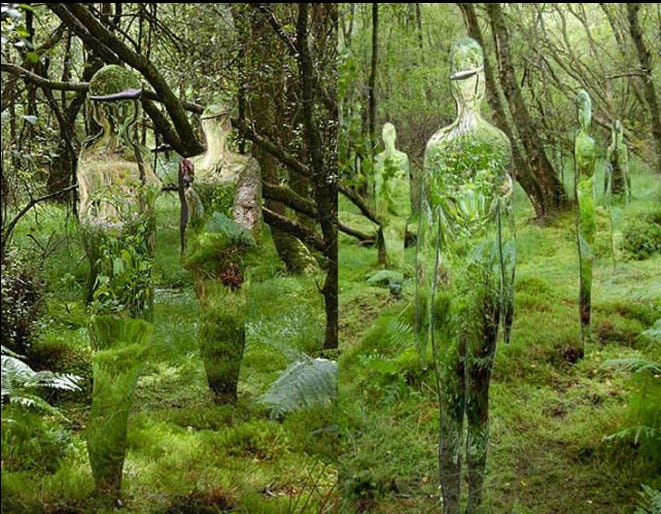
To be alive now in Anthropocene culture can feel like being lost in a hall of mirrors. We’ve been indoors for a century, online for a few decades, and now submerged within screens that reflect back endless iterations of the indoor and online world. Only humans matter, the mirrors say, but we don’t know why. Some mirrors we build on our own, but most are being built for us by those who profit from our self-absorption and subsequent neglect of other life.
Nearly everywhere we go, we see only ourselves and each other in an endless network of fragmented reflections. Nature, reduced to background, is now peripheral. As we move deeper and deeper online, the fragmentation of culture pulls us in and fractures our attention, leaving only an unsure sense of being human in a broken human world. The real world outside the hall, meanwhile, has been diminishing in direct correlation to our failure to see ourselves within it.
Years ago, while working in Antarctica and watching how much of our time - socializing, watching movies, turning inward - was spent oblivious to the astonishing otherworld of ice we inhabited, I scribbled into my notebooks this line: Mirrors were the first TV.
I meant, I think, to pin down how we could get so lost in ourselves that we lose the world too.
We are an obsessively social species whose consciousness (personal, societal, cultural) is constructed from stories about ourselves in the context of other people. So it matters, in absolute terms, what stories we tell. It matters what stories we are told, who they include and why they matter, and it matters which stories we believe and act upon.
There are plenty of other species whose altricial young need to be taught how to live, but we are the only animal born as a blank slate that can be weaponized against life itself.
Anything You Polish With Attention
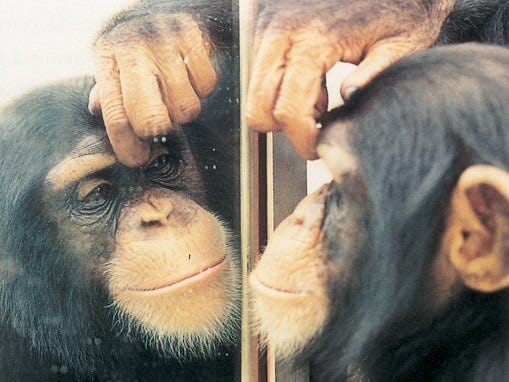
Modern humans spent most of our first few hundred thousand years without any way to see ourselves except by glancing into still waters. The history of mirrors dates back only a few thousand years, and for nearly all of that time mirrors were rare treasures in wealthy hands. I’ve often wondered about the consequences of the radical psychological and social shift from those nature-based glimpses of ourselves to cultures full of mirrored reflections, of images in art and photographs, and now a flood of constant self-seeing.
I’ve read that there was among the ancient Greeks a superstition that seeing one’s reflection in the water - perhaps a glimpse of the soul - was unlucky or even fatal. The story of Narcissus falling fatally in love with his own image might be an expression of that fear, but here and now it’s tempting to see the myth as a metaphor for a culture that collapses into the empty spaces between mirrors, photographs, and screens.
We’ve forgotten what it means to live an almost entirely image-less life, in the real world, as our ancestors did for thousands of millennia. How many of us can imagine it? And what would it mean to only see our reflection outside, framed by the living world?
My query here, then, is not about the narcissism of a selfie-taking society, but about the likely ecological benefits of seeing our faces most often in nature rather than in a frame on a wall in the built world. What if the ethical framework for our inward lives was rooted instead in looking outward?
The wise Maria Popova likes to say that “Anything you polish with attention will become a mirror,” revealing something about our deeper selves. Likewise, I used to tell my students that “what we practice is what we become.” So much of what our culture polishes now, though, reflects badly on us. I don’t mean this in the personal sense, since most of the blame lies with those remaking the world in remarkably stupid and harmful ways, and ensuring that we are trapped within it.
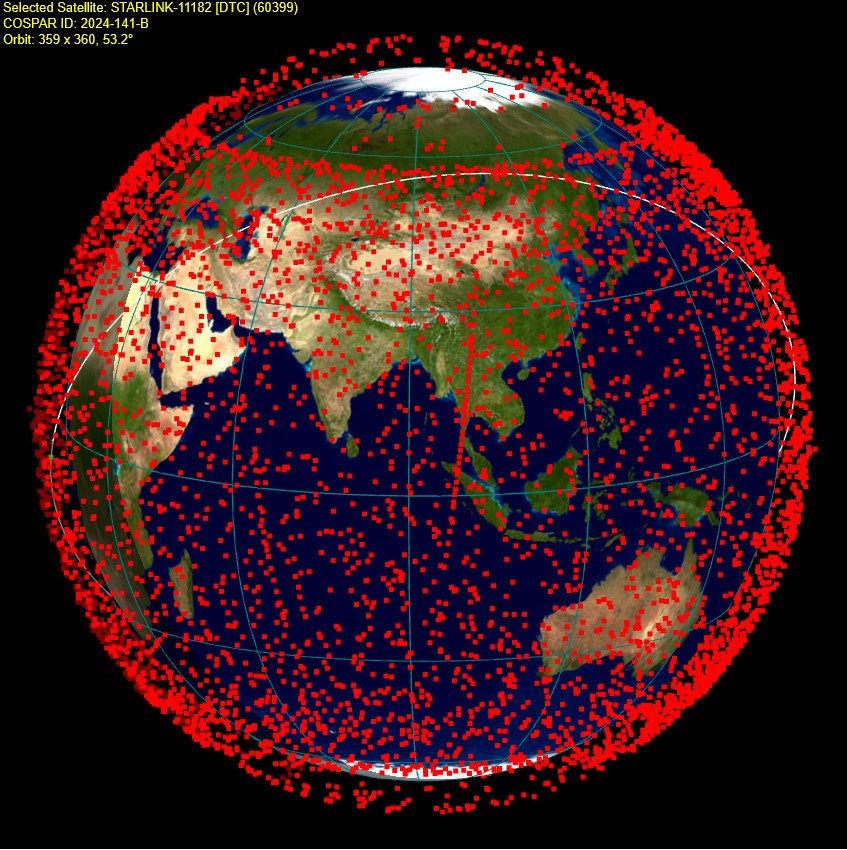
I mean the Earth-breaking systems we’ve built and polished for energy, agriculture, transportation, and materials. I mean, among many other mistakes, the bright shiny chemistry of industrial contamination, the nacreous glistening of oil on water, and the thousands of glinting satellites now turning the planet’s orbital space into the next planetary emergency.
Mirroring a Particular Human Weakness
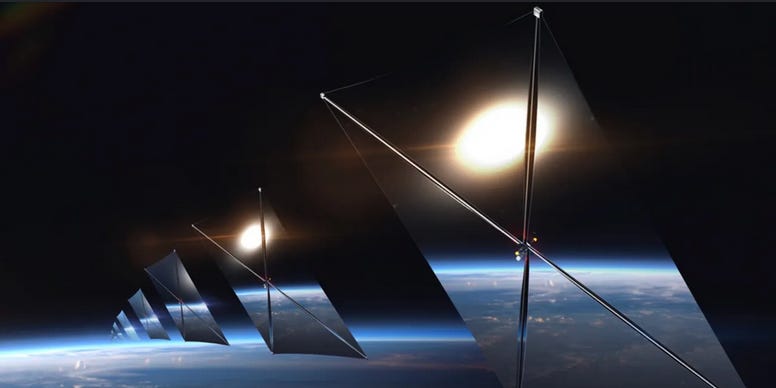
I’ve written, in “The Sky is Falling” and “Shoot the Moon,” about the dangers of the rapidly growing Starlink arrays and the lunacy of trying to colonize the Moon, but I have to add another weird shiny toy to the stratospheric mix: Reflect Orbital’s plan to launch tens or hundreds of thousands of satellite mirrors to provide “sunlight on demand” at night across much of the Earth.
Mirrors in orbit that provide nighttime sunlight at a price: It’s yet another concept/product in a global culture that seems to have no ecological principles, that cannot imagine either hard limits to growth or the consequences that come after, and that finds no meaning in the fabric of life except in its usefulness to us. You can call this capitalism, but capitalism only mirrors a particular human weakness: the tendency to believe - if we haven’t been raised to respect other life - that we are what gives the planet its meaning.
I wouldn’t take this project seriously except for a) its pending FCC approval and b) the consequences. The minds behind Reflect Orbital believe there is a market - 24-hr solar energy production, industrial sites, disaster response, agricultural production, military operations, urban safety, and entertainment events - for nighttime sunlight on demand. They claim that their 54 m/177 ft-wide mirrors will provide delivery of pinpointed light (5 km diameter or larger) that’s dimmable (from “noon light to moon light”), uniform in intensity, and easy to turn off and on. They’re planning to launch their first satellite (18 m wide) this year, and claiming that they’ll install a megaconstellation of more than 50,000 by 2035. The founder has suggested the number might someday increase to 250,000 satellites.
Why Banish the Night?
The least interesting but perhaps most relevant initial question is whether there is a way to profit from this (other than taking tens of millions of dollars up front from investors), given the massive costs of building, launching, and maintaining a vast fleet of satellites. Perhaps there are enough governments, militaries, cities, and festival organizers to sustain a small network of space-based mirrors, but the marginal increase in solar energy production or in crop growth seems unlikely to extract payment from anyone harvesting photons or corn, especially when batteries and dirt are both dirt cheap.
Boosting solar energy is apparently the main thrust of the business plan. But as a pair of astronomers explain, so little solar energy would be reflected by each satellite mirror that Reflect Orbital would need 3,000 satellites focused on a single large solar farm to reach their brightness goal of 20% of the Sun at midday. 250,000 of them, which is 16 times more than all existing satellites combined, could only supplementabout 80 large solar arrays. Solar is already the cheapest energy source we’ve got, and will only get cheaper. Boosting it a tiny bit with billion-dollar orbital investments is not a business plan.
Profit aside, can the plan work? Not on cloudy nights, certainly. Not if the constant rain of micrometeorites hitting Earth play havoc with these thousands of large fragile mylar mirrors. And not if these satellites fail to aim with extraordinary precision, as promised, night after night, for years at a time.
And even if it could work, should we allow it? Why banish the night when so little is gained? Who gets to choose? As astronomer Samantha Lawler noted in a Smithsonian article: “It’s wild that one little company in California, [with] permission from one agency that looks after radio transmissions, can change the sky for everyone in the world.”
How Unnecessary It Is
The list of problems for people and society is long. For astronomers, of course, it’s catastrophic “light pollution by design.” Lawler says that “the sky will be too bright to conduct the vast majority of astronomy research.” A Big Think article explains that the test satellite going up this year will seem a bit brighter than the full Moon, but concentrated into a light beam that can “fry a human retina” and ruin the optics of telescope lenses. A technical report equated the light source with a laser, with all of the associated risks.
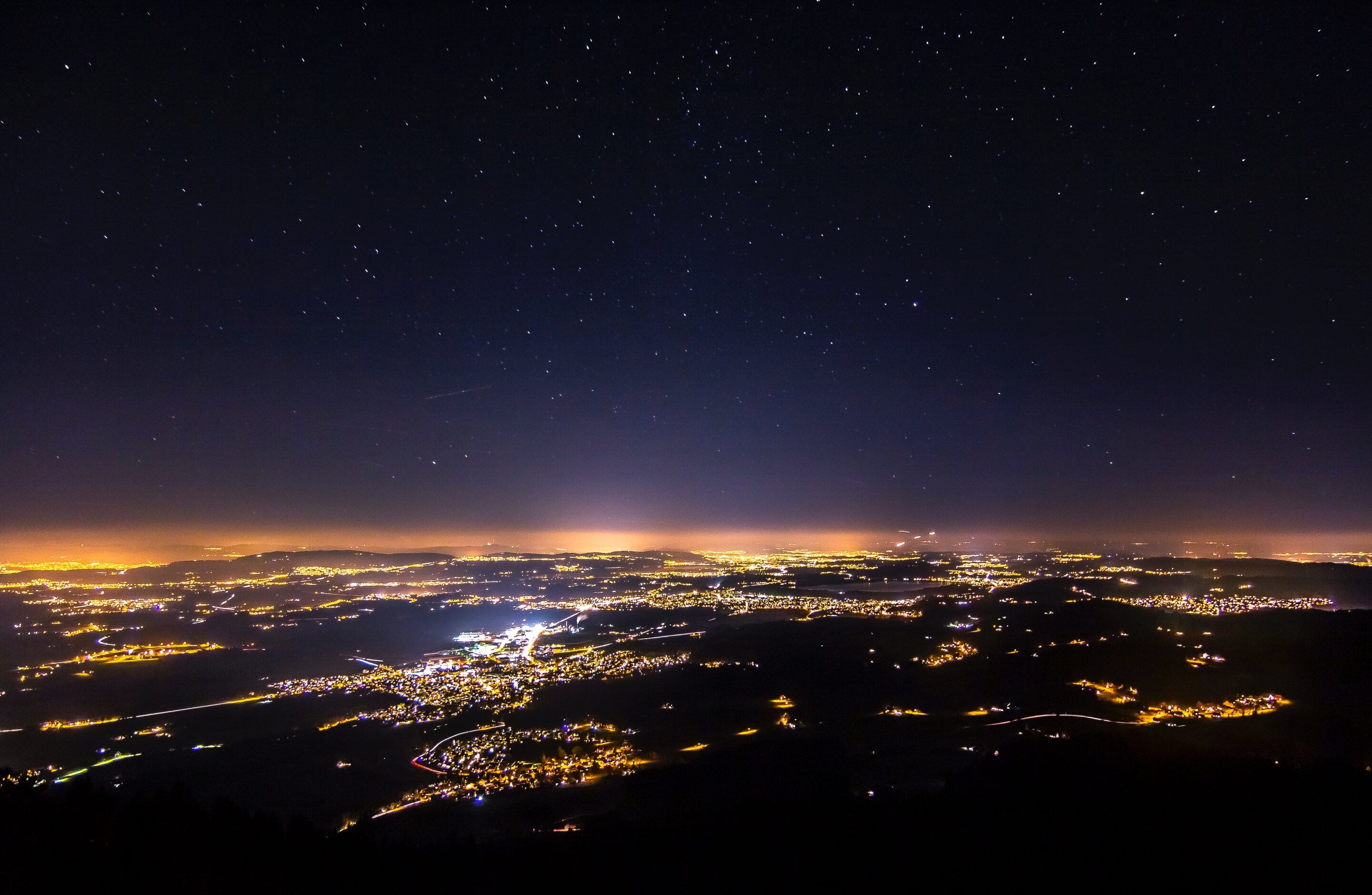
Stargazing for ordinary people, already difficult because of Earth-bound light pollution, will be impossible for far more of us if thousands of Moon-bright mirrors hang like spotlights in the sky. This will be true even in remote and wild places, as city-sized beams of light sweep across large areas that do not want them.
Worse, each bright source and light beam would disturb a far greater area that the intended illumination zone. (Think of it as a bright lamp in the next room keeping you awake.) Millions of people who don’t want their nights to disappear under the constant glare of false sunlight could be forced to do so anyway. And the health risks are substantial, as the Big Think article noted:
…the exposure to bright artificial flashes of light, even for milliseconds, can not only disrupt human circadian rhythms, leading to less and lower-quality sleep, but has also been linked to certain types of cancers in humans.
And it’s worth noting the consequences for all the other human infrastructure in low-Earth orbit, the satellites we rely on for necessary things like communication and navigation. The rush to launch thousands or tens of thousands of new satellites, especially at the high altitude Reflect Orbital is aiming for, increases the likelihood of a Kessler Syndrome cascade of satellite collisions that render a broad swathe of orbital space unusable. And these megaconstellations are intensifying the new Starlink-related chemistry problem of filling the stratosphere with tons of metal particles from satellite burnout.
In short, then, in the service-to-humanity analysis, this Reflect Orbital plan seems likely to become an abject failure. Too many risks, too many harms, no substantial benefits, and pie-in-the-sky economics: It’s exactly the kind of thing that shouldn’t get past the drawing board. As the Big Think article concluded,
The most unfortunate part of the Reflect Orbital proposal is how unnecessary it is. We already have solutions to all of the problems that it purports to solve, with none of the many significant consequences…
With any luck, they’ll launch their test satellite this year and all of these irrational chickens will come home to roost, and the concept will fade alongside its declining investments. Success seems impossible, because as the Conversation article put it, why the hell would we want “250,000 enormous mirrors constantly circling Earth to keep some solar farms ticking over for a few extra hours a day?”
The Shared Wilderness
Finally, I’ll point out that the entire sophisticated Reflect Orbital website is devoid of information or concern about how life on Earth actually works. As planned, giant space mirrors lighting the night would be a planetary-scale ecological nightmare, but the company vaguely promises a “healthier planet” (after human progress and economic growth) and the protection of “sensitive environments” (despite the harms of nocturnal disruptions to every environment). And they offer an ode to how the Sun powers all of life while seemingly oblivious to their planned disruption of that life, which has evolved over billions of years with the natural day/night cycle.
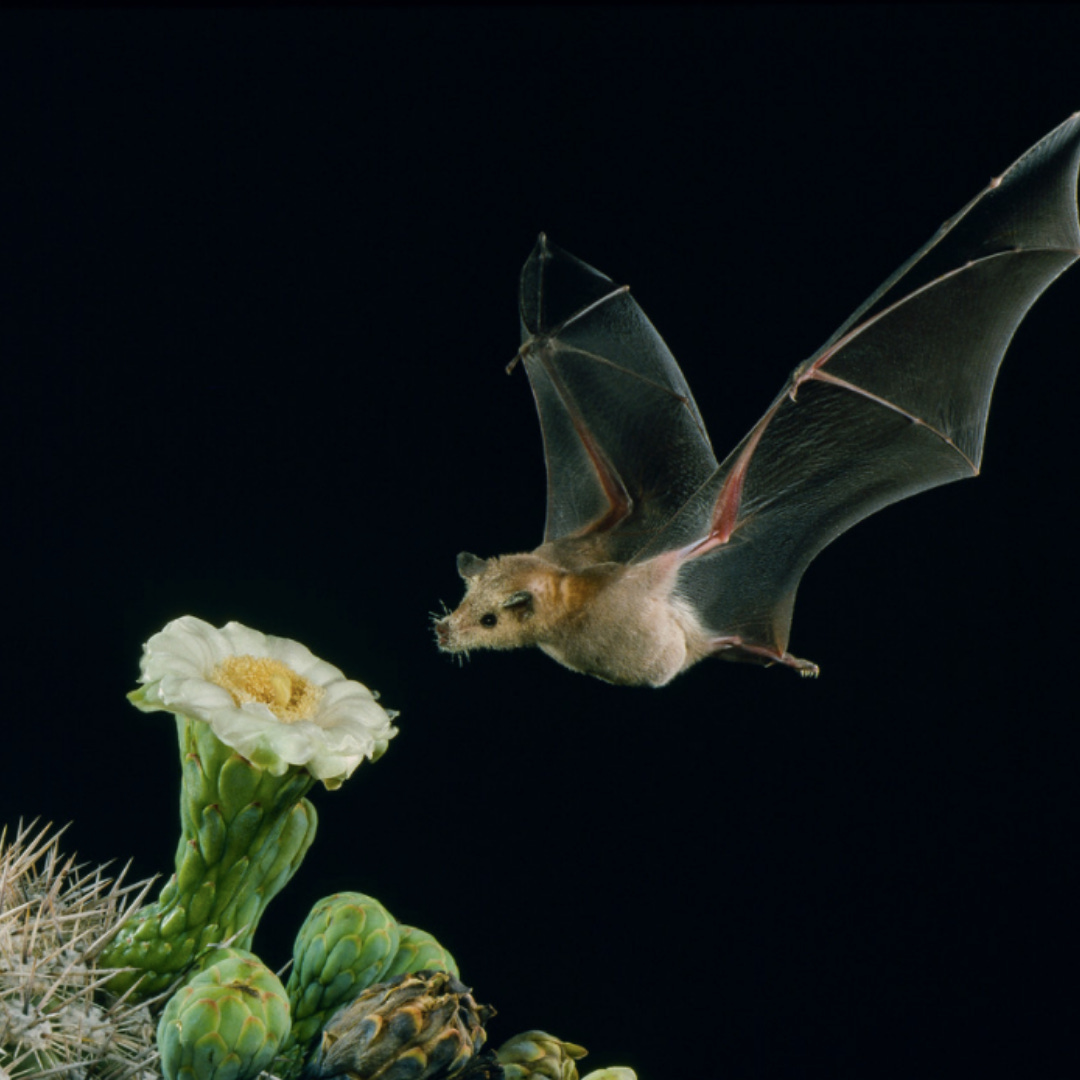
I shouldn’t be astonished - in a world of PFAS rain, corn for ethanol, and fossil fuel corruption - but still I am astonished at the refusal to understand or care about the harm they plan on inflicting. It’s well known how urban and industrial light pollution impact plant health and animal behavior; now imagine broadening those impacts to landscape scale. Half of what life does happens at night, whether it’s pollination or plant growth, migration or navigation, hunting or foraging, resting or sleeping. This profit-driven plan ignores all of that.
Reflect Orbital is yet another example of how alien our culture has become, threatening like off-world colonizers to disrupt much of life on Earth with 24-hr light just so we can slightly increase our electrical production capacity. No place would be safe from this space-based profit-driven light, not even the most pristine locations, in the same way that no place is safe now from a hotter atmosphere. Like climate change, agricultural pesticides and herbicides, overfishing, PFAS chemistry, Starlink’s constellations, and so on, Reflect Orbital’s plan is yet another untested planetary experiment by an alien society.
Mirrors were the first TV, I wrote. Now we’re trying to fit the entire planet into the mirror we can’t stop looking into, into the fragmented reality we’ve created out of our online lives, and into the story we’re being told about how the planet belongs to us.
For an excellent brief summary of the problems with the Reflect Orbital proposal, read DarkSky International’s letter of opposition to its FCC application.
An astronomer quoted by the CBC described the mirrors as a threat to the “shared wilderness” of the night sky, and I love that idea as a seed of the kind of ecological civilization we should be building. And many of us are planting those seeds. We’re outside, away from mirrors and screens, working toward the protection and repair of the shared wilderness both at our feet and far above us. Or we’re inside, telling better stories.
And that, in a too-mirrored world, is a better reflection to end on.
Thanks for sticking with me.
In other Anthropocene news:
From rebecca hooper and Between Two Seas, “we are not invisible,” a beautiful reminder that not only are we part of the natural world but also a stone whose weight and movements send ripples constantly through the community of life. This is both a gift and an obligation to pay attention.
From Bryan Pfeiffer and Chasing Nature, “A Songbird for a Damaged World,” Bryan’s beautiful ode to Palm Warblers.
From Yale e360, “Restoring the Flow,” a major step in the effort to restore part of the Everglades in Florida, as years of work finally led to the reflooding of some 55,000 acres of wetland once sliced and dried for a failed housing development.
From the Times, “The Hole in the Ice at the End of the Earth,” a moving and beautifully illustrated story about a South Korean scientific team working under difficult Antarctic conditions and an extremely tight timeline to become the first to drill through the Thwaites Glacier and place sensors to better understand the collapse of the “doomsday glacier” that may someday lead to 15 feet of global sea level rise.
Also from the Times, Lithuania is hard at work restoring peat bogs on the border with Russia, partly to improve habitat, partly to increase carbon storage, and partly to create an impassable boggy barrier to Russian tanks.
From Nature Briefs, a thorough summary of how philanthropic funds for ocean research are spent, and how those funds are weirdly lacking, despite the oceans containing much of life on Earth.
From Anthropocene, AI applications are proving to be extremely useful in processing thousands of camera-trap images of wildlife, allowing researchers to more quickly assess the key conservation questions those photos are meant to help.
Also from Anthropocene, a study finds, unsurprisingly, that investing in renewables is much, much better for both climate and human health than investing in direct air capture carbon removal.
This topic came up recently in a conversation I had with the head of a gargantuan private credit firm. We were on stage at the World Policy Conference, speaking in front of top-tier executives and officials from around the globe. As a final question in our talk about geopolitical turmoil and systemic risk, I asked her a standard closing question: “So what keeps you awake at night?” Her answer: “Space.” Your article, Jason, outlines exactly what she was talking about. Thanks for shedding your incisive and eloquent light on this.
Amen to everything you say here.