
Something in the Fog
4/30/26 - Knowledge, ignorance, and action

Hello everyone:
As always, please remember to scroll past the end of the essay to read some curated Anthropocene news.
Now on to this week’s writing:
More Miracle Than Obstacle
Fog, a recent study tells us, is full of life. Bacteria inhabit the water droplets, feeding and reproducing, at a concentration similar to the density of microbial populations in both salt and fresh water. Fog, the authors tell us, should be considered a “potential aquatic microhabitat.” Even floating in a thin veil across an evening meadow, water is the stuff of life.
Fog is, to the fearful imagination, the stuff of lost children and shipwrecks. For a restless species who insists on being able to see everything, all the time, fog is an inconvenience and a metaphor for directionless confusion. One of my most haunting drives was a nighttime crawl through dense Newfoundland fog on fresh black asphalt with no painted lines and deep ditches on either side. The fog was bright in the headlights while the road disappeared beneath; we could scarcely tell we were moving.
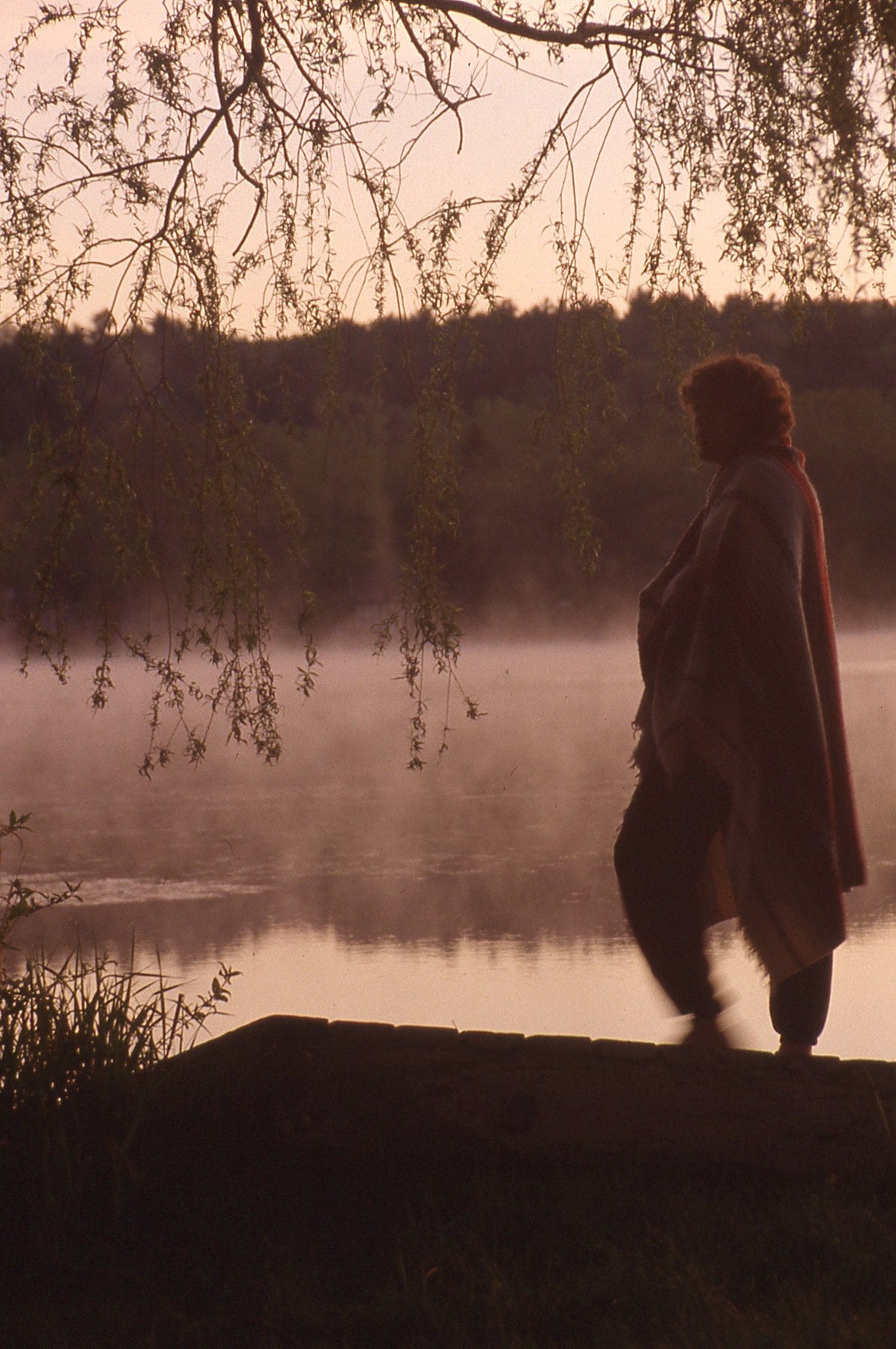
To the patient eye, though, fog and mist give shape and substance to the air, settling like sleep on field and pond or rising to dance in tendrils held between light and wind. When we’re in it without timetable or task, fog is more miracle than obstacle. To me, its hush hints at the soft silence behind all reality, and the taste of its damp breath on skin and tongue seems like food and drink for all of life. This new research puts data behind the aesthetics.
The aeroecology of Earth - life lived in the air - is marked primarily by the thousands to millions of bacterial cells occupying every cubic meter of atmosphere. These cells rise from the soil and plants of the green world into the invisible swirls of wind, and form the backbone of most raindrops and ice crystals. As I wrote in “Life is in the Air,” the living rain, snow, dust, and wind are kept company by the astonishing swifts and other birds, by bats, and by flying/migratory insects and airborne newborn spiders whose silk thread sails give additional meaning to the “web” of life.
The Flood
In my decision to write a little about the scale of our knowledge this week, I could have rooted this essay in any of the hundreds of articles that pass before me day after day. Some recent favorites include efforts to “daylight” streams and waterways long buried, the connection between Mennonites and Amazonian deforestation, the horror of “mirror organisms”, and a true understanding of the proton-driven flagellar motor in single-celled bacteria, one of the great evolutionary developments and a key to understanding how all of life works:
This amazing, self-assembling, signal-processing, direction-switching molecular machine is so powerful yet so spare that, billions of years later, it’s still used by bacteria in virtually every gut and puddle on Earth.
My point is that we live in a time of great knowing. Fascinating discoveries come to light every day. Some (like the living fog) are about the beautiful world, some are about our abuse of it, and a few are about our efforts to repair the damage. The raw material of information, and the processed product we call knowledge, are both wondrous and excessive. They flood around us and through us in great torrents that carry us, ironically, toward an unpredictable future. We sip or swig at the flood, depending on our capacity and thirst for knowing, but we no longer live in a time when any of us can hope to master (or even be aware of) more than a fraction of what has been learned.
Science is a learning system, the most consequential that our species has invented. I might agree that it’s the best way of knowing ourselves, the Earth, and our galactic context, if it weren’t for the relentless destruction of life that has accompanied it. All the wise and thoughtful scientists I know are dedicated to the path of pure science - the optimistic quest for knowledge - but science is only an advisor to Anthropocene culture, not its guide. A culture that strips the Earth for parts will always scavenge pure science for paths to profit and power, leaving its higher motives to gather dust in academic journals.
Rob Lewis made a similar point in his recent series of posts on plant intelligence, Indigenous ways of knowing, and the fate of the Black Hills:
Science can be a powerful, fascinating, and for those that practice it, immensely enriching undertaking. But, in the absence of respectful, mutual relationship with the more-than-human, it can result in great harm.
The problem is that science, like democracy, does not come naturally to us. They are both smarter than we are, both aspirational ideas invented by, but not wholly embraced by, several billion story-driven social apes who are as irrational as the scientific method is rational.
Writer Terry Pratchett reminds us that science is less about facts than about seeing the world clearly. “It is,” he says,
a method of asking awkward questions and subjecting them to a reality-check, thus avoiding the human tendency to believe whatever makes us feel good.
But I wonder sometimes if the sheer volume of the flood keeps us trapped in our comfy beliefs. If science is a river too deep and fast to swim, and if its genius is too often co-opted by industrial profit-driven forces we cannot resist, then we spend most of our lives sitting on the bank of the river, marveling at or afraid of what we do not understand.
Each year, up to five million science papers (and other scholarly works) are published. Likewise, over four million books. Then there is the cascade of articles, reviews, interviews, etc. that follow some of those publications. And none of this accounts, of course, for the chatter and debate about what we think we know within the hundreds of millions of Facebook and Twitter posts and uploads, and about 400 billion emails.
How do I know any of this? I spent a few minutes looking it up. It will slip out of my head as easily as it entered. We live in a fog of information, a fog that’s everywhere but intangible, claustrophobic but endless, navigable only for a few steps at a time and blind to much of the long dark road ahead.

A Song We Were Meant to Sing
Here’s a thought that wandering in the fog might evoke: Knowledge is a scaffolding built to carry the weight of something much larger than itself: our ignorance. The mass of what we don’t (or can’t) know is both vast and often invisible. And, I would argue, it is just as beautiful as all that we have learned.
Most of the universe is a complete mystery, though we have empty files labeled “dark energy” and “dark matter.” Here on Earth, we can’t map the ephemeral existence of clouds, the endless fungal filaments in forest soils, or the complex interplay of microbes in our own bodies. We don’t know how many species there are or what it feels like to be a rat, flounder, warbler, or hedgehog. We don’t understand our own consciousness, much less that of a phoebe on a fencepost.
This sense of the unknown and unknowable might be a spiritual feeling for you. For me, it’s both physical and metaphysical. We’re clever apes, not gods, but the unknowability of so much of reality feels like a song we were meant to sing.
It’s helpful, I think, to imagine knowledge as a sphere growing in size. It becomes larger and deeper by the day, but its expanding surface area continually comes into contact with an ever-widening amount of unknowns, like a light-fed planet hanging in the darkness of space. Every answer begs more questions.
What ignores us saves us, as I’ve written before. We need to be as cognizant of the mystery of existence as we are confident in our clever inquiries. The astonishing amount of information and knowledge we have accumulated about the real world - from gravity to nematodes to our bodies’ interstitium to Amazonian ecology - is a cause for celebration but not for hubris. We suffer a diversity of blindnesses. What we don’t know still exists at the scale of the universe, and is echoed all the way down to the scale of a quark.
The relationship between knowledge and ecology is primarily ethical: We either widen the circle of our empathy to include other life in all its mystery and vitality, or we stumble through the consequences like children lost in a fog.
The Path Into Mystery
We must embrace life - even those marvelous fog-riding bacteria and their proton-driven flagellar motors - or else we commit ourselves to the loneliness of aliens without a home planet. Knowledge should always, always move us closer to the mystery, rather than helping us pretend we have somehow surpassed it.
Our flood of knowing is not itself a wisdom that teaches us how to live. We might all define that kind of wisdom differently, but it’s not the wisdom we need if it doesn’t include a love for all the life that we know surrounds us, a loving defense of what remains amid our destruction, and a loving acceptance of our existential need to become less destructive. We need guardrails on the long dark road ahead. We need a set of ethics for both scientific inquiry and culture more broadly to ensure, eventually, that all human activity is beneficial to life.
To do otherwise is to advocate for shipwreck on a clear and starlit night.
Recently, in Nature Briefs, Rhett Ayers Butler wrote a thoughtful remembrance of the important botanist and conservationist Peter Raven, who in the 20th century helped evolve our view of the living world from a mere collection of species to an ecological community of connected lives, a community increasingly under threat by human expansion. Raven, Butler says, was adept at conveying this larger picture to both scientific and lay audiences, and his life’s work was characterized by reflections on that larger picture:
What emerges from these reflections is a consistent theme: the idea that knowledge carries obligations. To understand the interconnectedness of life is, in his view, to recognize the consequences of disrupting it. Yet he resisted fatalism. Even as he documented accelerating rates of extinction, he maintained that there was still time to act, and that action would be most effective if it combined scientific insight with social and economic change.
Knowledge carries obligations. Effective action is rooted in both science and ethics. That feels like wisdom.
As does Robin Wall Kimmerer’s query to her Earth-loving students, in Braiding Sweetgrass, about whether they believe that the Earth loves us back. For those who see the planet as a pile of resources, as well as for those of us rattling the Anthropocene cage because we feel both trapped and complicit, that seems deeply unlikely. But existence is not a set of quid pro quo transactions, Kimmerer reminds us. It is a gift economy.
This came to mind when I read about the fog-as-life study in a Nautilus article, because it’s not just that bacteria are living and reproducing in their dreamy floating aquatic microhabitat. It’s that much of the microbial population is a host of methylobacteria breaking down industrial pollutants like formaldehyde. They are a “hub of active detoxification,” a gift in response to the changes we keep making to the ancient order of things.
It is a gift that evolved to expect gifts in return.
If they’re detoxifying “our” air, the least we can do when we step out into the mist is to pay attention to all that we cannot see. We can begin by recognizing, as we breathe in the fog, that everything we know is a path into mystery, not out of it. In doing so, perhaps we begin to humble ourselves before the much greater sea of life, all that embodies and cares for us.
Thanks for sticking with me.
In other Anthropocene news:
From Antonia Malchik and Trespassing (formerly On the Commons), “Private property: bedrock . . . or shale?”, another of her brilliant and fierce essays interrogating the false promise of private ownership, and how for centuries now it has continually corroded the common good, both human and more-than-human. Privatization of the natural world and of our physical and digital lives is not about security and independence but about power and profit. We think we own what we own, but in reality
…if someone more powerful comes along who wants to dominate that land in a different way, the bedrock contained in the idea of private property allows them to do so.
The same is true of water, electricity, seeds, air, trees, rare earth minerals; knowledge, imagination, your mind, your relationships. The law as it currently stands does not protect life. It doesn’t even truly protect rights. It protects property. And the transformation of property into power compounds over time.
From Yale e360, India is rapidly becoming the first major nation to power its industrialization phase with solar. Burning coal - like all wealthy nations have done - has been their plan, but solar is by far the cheapest source of power around the world now. By 2029, 280 square miles of a salt desert will be covered by 6o million panels, enough to power Austria.
From Northern Woodlands, a short sweet essay about a backyard red maple, a girl who preferred climbing trees with Thoreau in her pocket, and the beauty of samaras in flight:
Once upon a time, my backyard maple tree was a seed hitched to a samara that flew. If butterflies can remember a scent or a taste from their caterpillar days – the green, leaf-munching time before their entire body dissolved and reconstituted itself – is it a great stretch to imagine a tree holding somewhere in its body the memory of flight?
From ASU News, “Asphalt is everywhere, but it is bad for our health?”, research reveals that the volume and toxicity of VOC emissions from asphalt are, yes, terrible for human and environmental health, and that our hotter world is making emissions worse. The good news is that new asphalt formulations that reduce that toxicity are possible, including the use of algae to bind those VOCs.
From Daniel Martin Eckhart and The Rewilder Weekly (and thanks to Andy Revkin for bringing it to my attention), that article I linked to above about “daylighting” long-buried streams. Eckhart explains the history, the increasingly popular solution, and its benefits:
And once you’ve daylighted such waterways, in essence restored them to their rightful and meaningful place, they’ll be the gift that keeps on giving. People will begin to mingle, to enjoy, to be mindful, to take care. Local governments will support with tree planting and biodiversity riverbanks. Rivers will also deliver on their cooling effect - benefits all around for everyone.
From High Country News, a wonderful ode to flies, and what they can teach us. While practicing meditation in her Colorado yard, the writer often finds that wildlife - like deer, mice, and birds - would lose their fear and treat her like part of the landscape. Flies would land on her in numbers, but rather than becoming annoyed, she taught herself to accept the life that had accepted her:
To the flies, I was simply another patch of earth. The land doesn’t flinch and complain when a fly lands on it. I surrendered and felt myself dissolving into the land itself. A sense of effortless belonging arose when I quit pushing away the natural world — the beautiful and the ugly; pleasant and unpleasant; the flies, flowers, sun and breeze. I was learning patience: Raging against flies would accomplish nothing but disturbance within my own mind.
From David Roberts and the Volts podcast, “Sooner than you think, electricity is going to be cheap, abundant, and boring,” an upbeat conversation about how utility-led expansion of batteries across the grid will (might?) solve the grid’s problems.
As always, from Sam Matey-Coste and The Weekly Anthropocene, an excellent collection of good-news energy and conservation stories. This week includes superpods of humpback whales, the astonishing surge in grid-scale batteries, endangered langurs thriving in Singapore, and an artist down the road from me here creating exquisite seabird decoys to be used in conservation projects.
From the Revelator, “Dangerous Drinking: Is Bottled Water Really Safer than Tap Water?”, a review of the plastic problems, false advertising, and toxicity of our bottle water addiction.
I wonder what the micro- and nano-plastics that are in the atmosphere and thus in the fog are doing to the life in the fog.
“Knowledge should always, always move us closer to the mystery, rather than helping us pretend we have somehow surpassed it. Our flood of knowing is not itself a wisdom that teaches us how to live.” Yes, yes, yes. I love this essay. It’s such a powerful reminder that while science can open a door to awe and wonder, we need to move beyond the written word to glimpse the wisdom of the living world that will always remain beyond our understanding. Thank you.