
Feral
4/9/26 - Our love of cats vs. our love of wildlife, Part 2

Hello everyone:
This is a difficult topic and long essay. I hope you’ll take the time, as I have, to consider this vital story. The fate of tens of billions of wild animals is the backdrop to our ethical quandary regarding feral cats.
As always, please remember to scroll past the end of the essay to read some curated Anthropocene news.
Now on to this week’s writing:

Everywhere on Earth
I’d never had reason to consider the problem of feral cats until I was deep into a ten-day hike on Stewart Island in the far south of New Zealand, sometime in the late 1990s. The island is still one of my favorite places on Earth, a large nearly sub-Antarctic island with one small fishing/tourist town backed by miles and miles of wild, rainy, storm-tossed forest at the edge of the world.
Among the dozens of birds on the island, bellbirds and tuis sing the forest into life, kiwis and wekas haunt the underbrush, yellow-eyed penguins and oystercatchers greet the tide, while shearwaters and mollymawks soar between breaker and gale. There are 28 km of roads to drive on, and 280 km of trails to hike. Year after year, I went back to the island, and to that long hike, during my decade of looping through Antarctica, New Zealand, and Maine.
Once, on the far side of the island, maybe five or six days in, I had just left a hut for another day of muddy walking through deep green fern-filled forests and along miles of empty windy beaches. And then I saw a cat. It appeared cautiously out of the bush atop a sandy coastal cliff, without acknowledging me, before disappearing back into the forest. And suddenly the scale and scope of the planet’s feral cat problem became real for me.
It wasn’t just that this cat was somehow at home in the wild many miles from town on this large impenetrable swampy island. And it wasn’t just the horror of imagining the innumerable victims of this cat and its brethren, over many decades, in a place full of native birds and other species who have not evolved with any of the usual feline, canine, or mustelid predators. It was the realization that if feral cats were there, at the edge of the world, then they were everywhere on Earth, in numbers and with consequences that would be hard to imagine.
Wild Thing?
To be feral is to live in a tangle of wildness and neglect. Once a part of human society, feral animals have either slipped away or been cast aside. A typical definition - “existing in a wild state, especially describing an animal that was previously kept by people” - makes clear that being feral means existing in the ever-widening gap between what we call civilization and what we call nature.
Our empathy waxes and wanes when we consider a list of feral animals around the world. I dislike feral cats for eating native birds but worry about the fate of feral dogs in Ladakh and feral horses roaming the western U.S.. I think pigeons (feral rock doves) on the streets of NYC are beautiful, but understand that millions of intelligent feral hogs tearing up habitats across North America need to culled. And how should I feel about the million feral camels in Australia?
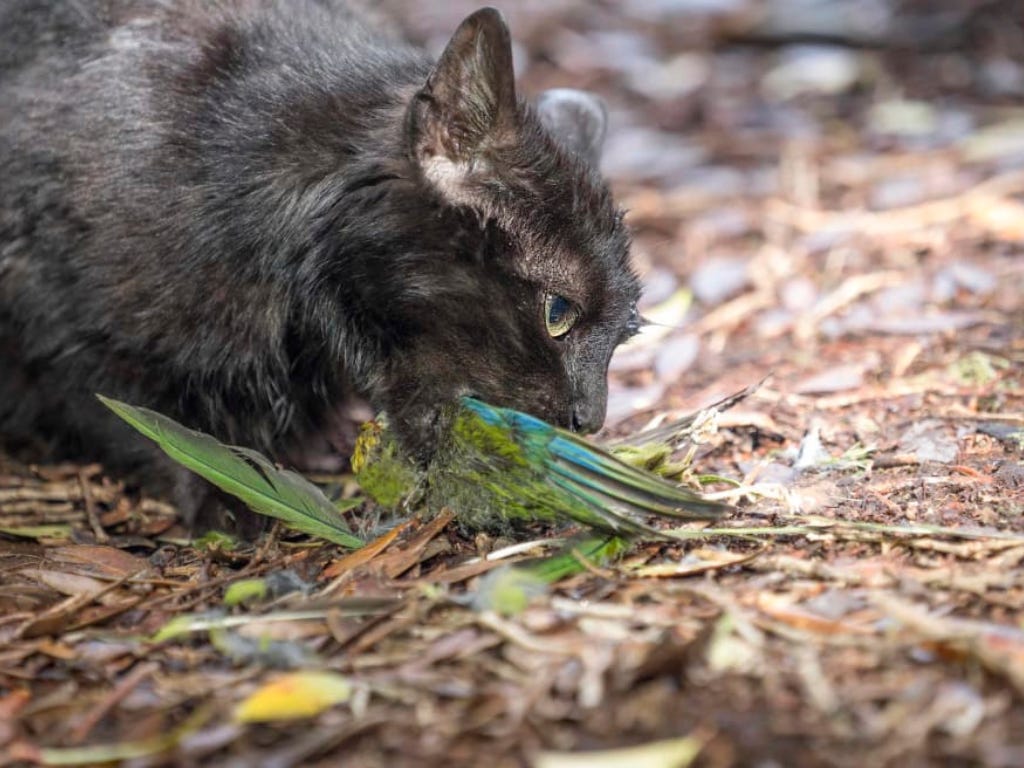
Cats are the most widespread and most harmful to native wildlife of all the feral species that have slipped the bonds of human company, or who have been thrown away by a throwaway society. Of the estimated 600 million to one billion cats in the world, most (480 to 600 million) are feral. The consequences for other species that fall prey to cats, as I outlined last week, are enormous.
The strong feelings that we have about the problem of feral cats are rooted in whether we see them as an incredibly predatory invasive species posing as wild animals, or as abandoned pets who need our help. Both are tragic stories, and both are at least partly true, but there is only one ecological truth here: Feral cats kill far more wildlife than domestic outdoor cats, and the impact of their killing many billions of animals is felt across the globe.
Sharp Fragments
Feral cats are an artificial fragment introduced to a fragmented natural world. Here’s a story of city outskirts and the suburbs: Fill in the wetlands, cut back most of the forest, pave the fields for homes and roads, leave only scraps of habitat, and then introduce a community of cute fuzzy perfect hunters to scavenge among the struggling native species.
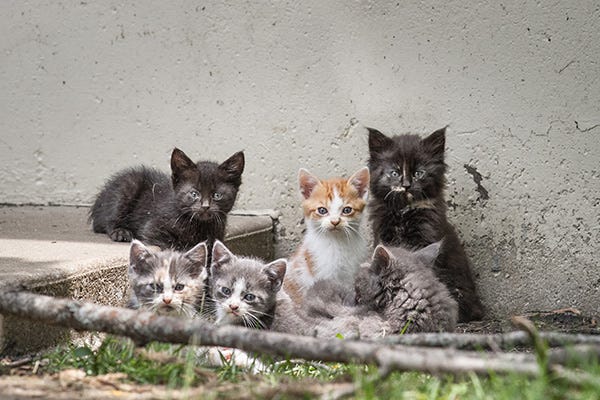
Yet the cats struggle too. Feral existence is marked by far more disease, roadkill, and hunger than occurs in house cats. It is rarely a good life. One study found that 75% of feral kittens die within six months, mostly from physical injuries. A statement from PETA (People for the Ethical Treatment of Animals) outlines in gruesome detail the suffering of outdoor cats, argues that no cats should be living outside unless fully cared for, and concludes that it’s often better to euthanize cats who cannot be domesticated.
When well-meaning neighbors feed these “community cats,” they prolong the cats’ difficult lives and worsen their ecological impact. Cats are obligate carnivores, so even a reliably fed stray will continue to stalk and hunt and kill. They end up as invasive predators under our protection, rewarded for their killing yet rarely hunted by native predators like coyotes or wolves. Like us, they are neither truly wild nor a balanced link in the food chain. Like us, they take much more from the world than they contribute.
What the Mountain Knows
At the risk of sounding like a Boston native describing traffic on the Southeast Expressway, feral cats are one more example of a “wicked problem,” which are proliferating in the Anthropocene. Characterized by social complexity that defies solution, wicked problems like poverty, climate change, and contamination of drinking water haunt our shared future. As we torque Earth’s atmosphere and oceans while fracturing her living systems, we create problems that defy ordinary debate and resolution. Just to cite one recent example, there’s a plan by owl-loving wildlife managers to cull half a million barred owls whose rapid spread westward (because of our changes to climate and habitat) threaten the existence of spotted owls in the Pacific Northwest.
The ethics of shooting these owls, cats, and camels are as heartbreaking as the logistics. These are problems of our making, and the solutions are our responsibility. Yet again and again we either identify the animals as the problem or deny the problem exists, which only makes it worse.
It raises hard questions: How do we justify culling these marvelous animals if we also acknowledge that their predatory lives on the margins of society are not their fault? In a world disrupted by human activity, how logical is it to prioritize wildlife over feral cats? Aren’t feral cats just doing their best to become natural predators in an ecosystem? Who are we to intervene? Who gets to decide what’s best for the cats?
And we must admit that these millions of semi-wild cats are still cats, with rich social lives, endearing characteristics, and a lovely purr when happy. The potential of those lives, if lived within the bounds of human care and protection, is beautiful and extraordinary.
But if potential is our measuring stick, then we must also remember the global blossoming that would occur if feral cats were not out there shredding the fabric of life. Each year, there would be billions more birds, tens of billions more small mammals and reptiles and dragonflies, and so much more. The reduction in the landscape of fear in a world without feral cats, would bring that fabric in closer to us and our daily lives, which would be another source of joy. We’re happiest when nature is close at hand. The soft cats under our needy hands are, after all, a proxy for that need to reconnect with nature.
Again, I think it’s best to fall back on the deepest of truths, which are expressed by the world that has nurtured our species. As fragmented and upended as nature is, it should still guide us. Aldo Leopold articulated the guiding principle in A Sand County Almanac:
A thing is right when it tends to protect the integrity, stability and beauty of the biotic community. It is wrong when it tends otherwise.
We need, Leopold says, to “think like a mountain,” to remember back a thousand years to understand what the biotic community is, and what it needs.
And the mountain knows that the cats do not belong.
Seeking An Ethical Strategy
What, then, do we do? What we’ve been doing - where we’re doing anything - has not been working.
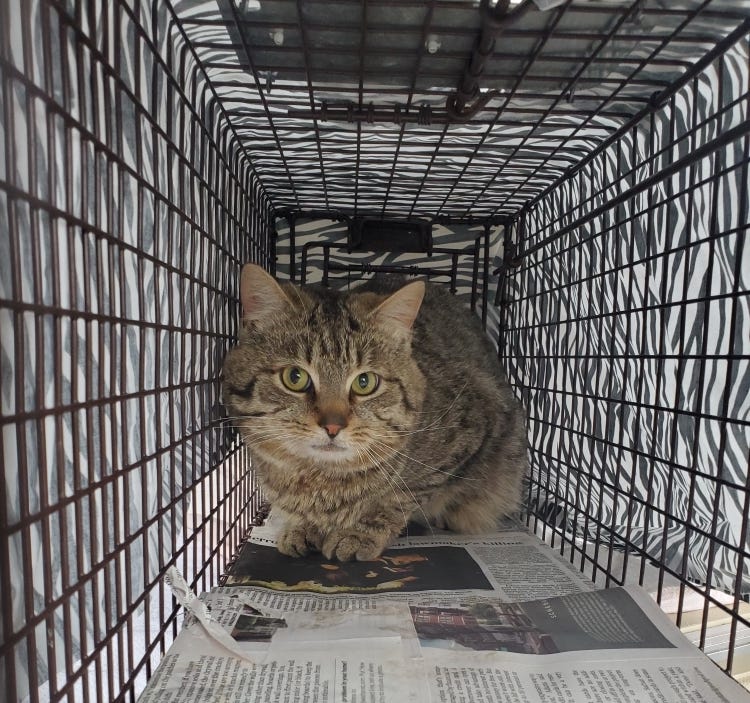
The primary strategy for controlling feral cat populations is TNR - Trap, Neuter, Release. Cats are captured, brought to a vet for spaying/neutering, marked to avoid unnecessary future capture, and then released back into the colony. If enough cats are controlled in this way, its advocates say, the population will stop growing and then decline. Unfortunately, the logic is better than the results.
The research, again and again, finds TNR to be ineffective. Too few cats are captured, for one thing. If even a minority of cats aren’t neutered, their breeding rate will outpace the control. Worse, people continue to abandon their cats or kittens in areas where community cats are fed and TNR is practiced, assuming their cats will be cared for.
It’s no doubt true that, as advocates point out, there is a lack of resources for TNR in some places. But TNR has, at best, stabilized rather than reduced feral cat populations. And then there’s the ethical problem. Here’s PETA’s statement:
Having witnessed the painful deaths of countless feral cats, we cannot in good conscience advocate trapping, altering, and releasing as a humane way to deal with overpopulation and homelessness.
And here’s one from The Wildlife Society:
Additionally, a strong argument can be made that returning (or re-abandoning) domestic cats to range freely is not an ethical strategy because of ongoing risks to the cats, other domestic animals, wildlife, and people.
Neither organization goes on to say much about euthanizing or otherwise culling feral cat populations, but beyond a tiny minority of cats that might be placed with caregivers, or the unfunded fantasy of creating large-scale fenced-in cat sanctuaries where neutered cat communities can live out their lives without harming wildlife, killing cats must remain part of the conversation.
Cat-astrophic
The argument for killing feral cats is easier - if still terrible - in those parts of the world where cats never belonged and where the consequences are the most stark. A Times article notes that Australia, where cats have contributed to the extinction of 34 animals, “has no native feline species but is home to a menagerie of slow-to-reproduce, snack-size mammals.”
The article describes walking into an outback office for a conservation group tasked with protecting threatened native marsupial species and finding a small pile of cats shot by a hired sharpshooter the night before:
It was a scene to make most any cat lover squeamish, and Dr. Moseby, who grew up with pet cats, once would have been “outraged” by the idea of killing them, she said. But after repeatedly discovering the half-eaten carcasses of greater bilbies and burrowing bettongs, just two of the reserve’s vulnerable residents, she had come to a stark conclusion: “You have to make a choice between cats and wildlife.”
And in many places Australia is making that choice for wildlife. Between 2015 and 2018, Australia killed 844,000 feral cats with poison and traps. A 2024 Guardian article describes a shooting campaign in the national parks of New South Wales as an attempt to slow the bleeding from the estimated 5 million deaths per day of native birds, mammals, reptiles, and frogs.
In New Zealand, too, as I’ve written about, the calculus is pretty clear. Many native species will only survive if cats and other introduced predators are eliminated. Some bullet points from Predator-Free Rakiura on the threat are instructive:
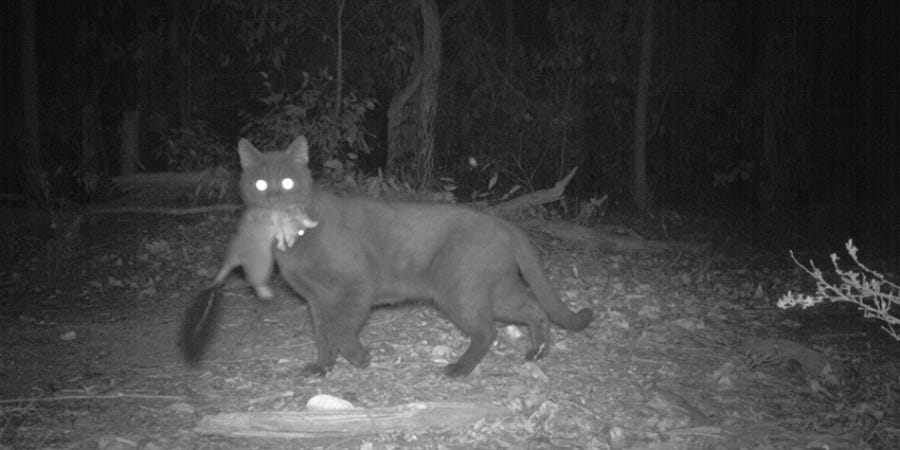
In 2021, in Central Otago, a single cat ate 28 native lizards in a single sitting, including McCann’s skinks and schist geckos.
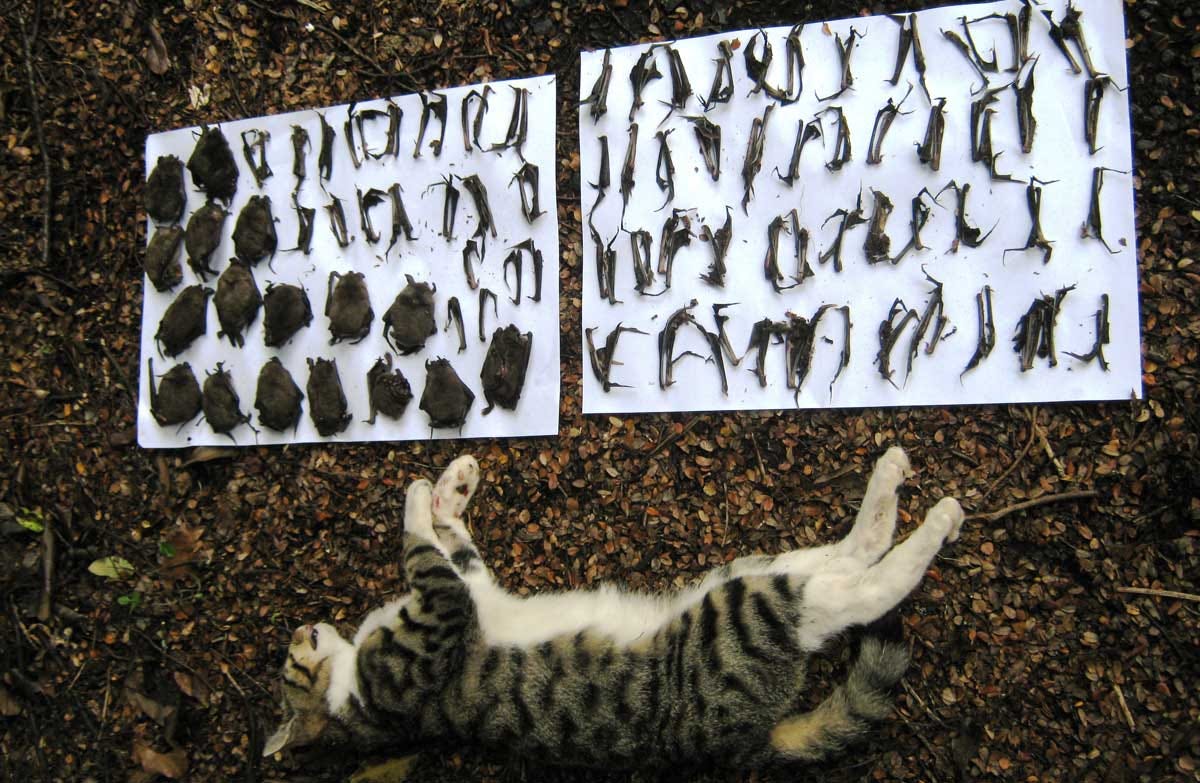
Another case recorded a cat devouring 107 bats (our only native land mammal) in a week.
In a single weekend in 2024, a feral tomcat decimated a colony of endangered Tarapirohe/black-fronted terns and their chicks and eggs, destroying 87 nests along the Clarence River. Only eight nests survived.
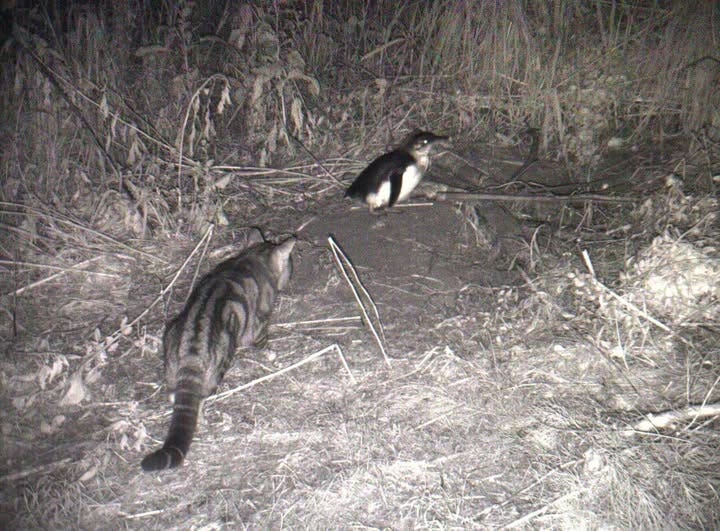
At Kaikōura, tūturiwhatu/banded dotterels face relentless predation from both feral and domestic cats. In one breeding season, 46 nests were established, yet only two chicks survived to adulthood.
Today, on Rakiura/Stewart Island, large-scale operations using poison and traps are already underway to clear the entire island of cats, rats, and stoats. I think it’s hard, even for cat lovers, to argue against the necessity, even as we all cringe at the reality.
But in Hawaii, “the extinction capital of the world,” protests erupted after state authorities passed a ban on feeding feral cats in some areas, despite the devastation from the state’s hundreds or thousands of feral cat colonies on many native species. A 2024 Vox article explains that the problem is literally everywhere:
even if the cat colonies are in urban or suburban areas, they can still do damage to threatened species. That’s the thing about Hawaii: Endangered species are everywhere, not only in reserves but in parking lots and golf courses. What feeding does, ecologists told me, is help sustain these colonies.
Because this is a wicked problem, Hawaii has found it easier to build miles of predator-proof fencing around seabird colonies than to deal effectively with the problem at the source.
High-Hanging Fruit
In this dilemma, justifying the killing of feral cats on remote islands or in nations with no native cat species is the relatively easy, low-hanging fruit. The cost of their presence is far too high, the impossibility of relocating them far too likely, and the value of creating predator-free oases for the protection of threatened birds and other species in an otherwise disrupted world is far too great.
But in urban areas or regions where some kind of native feline predator exists, and where endangered species don’t wander around parking lots, the calculus is less clear. The arguments against aggressive removal are stretched between two poles: empathy for the cats and benefits for us. Neither, however, seem supported by the science.
As I noted above, the life of a feral cat, even if reliably fed by volunteers, is shorter, rife with disease, and marked by injuries or violent deaths. Remember that even PETA does not consider the life of a feral cat to be a humane existence. The idea that hundreds of millions of cats should be allowed to live a life of increased suffering because of our empathy for them seems strange and selfish, if we can zoom out far enough.
But if we zoom in, and imagine being the hand that feeds them, it feels like love in action. And we’re rewarded for our love with whatever oxytocin-laden affection comes from these free-ranging cats. A not-very-convincing list of “benefits” to us from feral cat communities, as summed up by Alley Cat Rescue, centers on how the cats make us feel good while also reducing mice and rat populations. This a) assumes that we’d be devoid of pleasure without the feral cats, and b) ignores the research that finds cats aren’t particularly effective at mice and rat control. As a Feral Atlas essay on the impact of Wisconsin dairy farm cats on wildlife noted,
Researchers have found that cats do not effectively reduce populations of Norway rats (Rattus norvegicus) or house mice (Mus musculus). Rather than hunting these two introduced species as humans hope they will, cats are often more likely to prey on native wildlife.
Moreover, these cat colonies act as reservoirs for diseases which can spill over into human and wildlife populations. The American Veterinary Medical Association lists those which pose a threat to public health:
Zoonotic concerns include viral (e.g. rabies), bacterial (e.g. Yersinia pestis, Francisella tularensis, Campylobacter spp., Bartonella spp.), fungal (e.g. Microsporum canis), and parasitic (e.g. Cryptosporidium spp., Toxacara cati, Toxoplasma gondii, Cheyletiella spp.) diseases.
Of these, perhaps the most notable is the parasite Toxoplasma gondii because of its additional threat to wildlife. The Vox article lays out its impact in Hawaii:
Toxo has killed at least a dozen federally endangered Hawaiian monk seals, according to the National Oceanic and Atmospheric Administration. The parasite has also been linked to the death of several bird species and even spinner dolphins, according to the state.
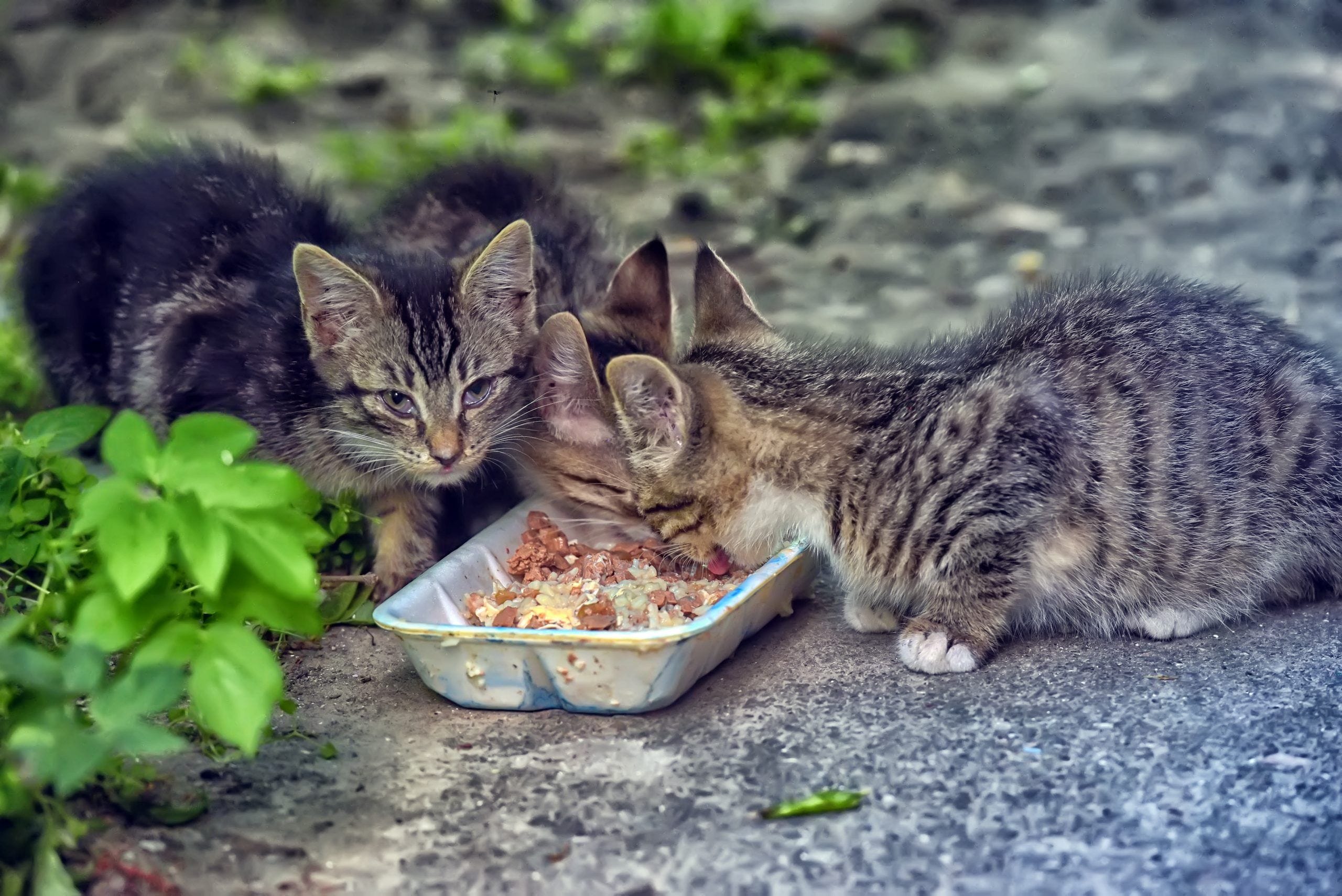
Still, though, our empathy for cats - as expressed through political willpower - often dominates the discussion. After an outcry, plans by the National Park Service to trap and remove a beloved horde of cats from the streets of Old San Juan, Puerto Rico, were shelved. The Feral Atlas essay notes that a proposed law in Wisconsin to allow culling of free-ranging cats was shouted down, despite enjoying majority support from voters. And in Hawaii, cat-lovers found ways to feed the cats despite the ban.
All of which means that in much of the world, good policy to fix this wicked problem is often still far out of reach.
A World Without Feral Cats
We can’t really quantify the benefits of cats in our lives. Those of us who love them simply love them for their companionship, grace, independence, and more. But we can quantify the cost of outdoor cats to wildlife, and by any genuine measure it’s far too high a price to pay. For this reason, we have to love both house cats and wildlife while turning against the existence of feral cats. We can do this with love and respect and a dedication to humane treatment, but it needs doing.
This division starts with language, with “feral”. Though they are identical in all but their behavior and setting, we label feral cats as distinct entities in order to separate our feelings and our actions. For most of these semi-wild cats, we can’t undo either the wildness or the neglect. Which means we have to treat them differently.
Love and empathy are part of the resistance to culling or isolating cat communities, but it’s a love that’s blind to the needs of the much larger, much more important living world. A defense of feral cats without true regard for their prey may seem like a reasonable choice, but I see it as yet another aspect of our ecological amnesia.
We’ve forgotten the lushness of life that recently surrounded us, and accepted its pale shadow rife with an excess of cute furry predators. Even in urban and suburban areas, which we think of as devoid of wildlife, the removal of outdoor and feral cats can invite those species back in, and help societies rewild those urban spaces.
To evolve toward a world without feral cats - which would be a more humane world - the to-do list begins at home and scales up to national policy:
Don’t let our cats out to roam. This should be both personal and public policy.
Don’t abandon our cats or kittens outdoors. Programs to accept unwanted cats should be fully funded, and abandonment should be penalized.
Spay and neuter house cats, and fully fund programs that spay and neuter feral cats.
Stop feeding strays and ferals. Feeding does not stop the hunting and prolongs a life full of suffering.
People whose cats harm wildlife should be treated by the law as it treats people whose dogs harm wildlife.
Replace TNR with policies measured as much by their effectiveness as by their humaneness. This includes humane euthanasia wherever necessary. The more impact cats are having on threatened species, the more euthanasia and culling will be required.
When I think back to my years of walking around the wild coastline and forests of Rakiura/Stewart Island, I remember it as incredibly lush: The bellbirds, kiwis, and penguins, the tree ferns and gale-bent manuka. Now, as the massive Predator-Free Rakiura program is underway, I wonder how much lushness I was missing after a century of cats, rats, and other species diminished the island’s flora and fauna. I don’t know if I’ll make it back to the island again, but I’m happy knowing that in some places in the world, at least, we’re taking responsibility for some of our disruption, however cute and fuzzy it might be.
For more on this difficult topic, you might want to read (as I have not) the book, Cat Wars: The Devastating Consequences of a Cuddly Killer, by Peter Marra, head of the Smithsonian Migratory Bird Center. Or you can watch a talk by Marra posted by the Cornell Lab of Ornithology.
Thanks for sticking with me.
In other Anthropocene news:
Looking for a beautiful children’s book about nature? I highly recommend Goldfinches, an extraordinary illustration by Maine author/illustrator Melissa Sweet of Mary Oliver’s poem by the same name. Each page is a brightly layered world to explore.
From Yale e360, “Why Protecting Flowers is Crucial to Our Future,” an interview with the amazing naturalist David George Haskell about his new book, How Flowers Made Our World. Some of you might remember Haskell from his role in the documentary film, Observer, which I wrote about last year. He’s always brilliant and exuberant in his love of the natural world. Here he is describing flowers:
Beauty is a flower’s way of speaking the language that animals understand. Pollinating insects are an example. Insects were mostly nothing but trouble for plants for three or four hundred million years, until flowering plants flipped the narrative by providing aromas and rewards like nectar and pollen that the insects could eat. They turned former enemies into allies through interspecies communication. Evolution found a way for plants to tap into animals’ aesthetics, and flowers forged new bonds of cooperation that made their reproduction way more efficient.
From the great Bryan Pfeiffer at Chasing Nature, “Power. Wealth. Success. Fame.”, an illustrated poem that subverts the social meanings of these words with an understanding of the deeper forces of nature that run the real world.
From Live Science, one of the most infuriating stories of our time - the deliberate poisoning of the entire planet with PFAS chemicals - articulated brilliantly in an interview with Mariah Blake, the author of a new book, They Poisoned The World. Blake describes PFAS as “the most insidious pollutants in all of human history.”
From ProPublica, the push by Republican-led states to provide legal shielding for oil and gas companies from the flood of lawsuits that seek accountability from these companies that have knowingly torqued Earth’s climate and threatened the stability of life across the globe.
From Inside Climate News, the Trump administration is proposing to cancel grazing leases on public lands for a major bison restoration program in Montana. The good news is that the legal language behind the proposal looks as indefensible as the move itself, and so may not survive the court challenges.
Excellent - a blight on our natural world that too many want to ignore. These are not cute kitties - they are killers.
Gosh, yes, this is such a horrible matter to have to consider. Thank you for bringing it to the attention of your readers. It is eloquently written (such that I didn’t notice the length you warned about) and an important reminder of the responsibilities we humans (to generalise) have to engage as ethically as we can with the problems that we have created. Thank you for this post.